How to be consistent with ADHD, most days instead of every day
Consistency that fits real life: most days instead of every day, one small step in view, a floor version for low days, and a way back after a gap that asks for no catching up.
The short answer
To be consistent with ADHD, aim for most days, not every day. Keep one small step in view at a time, give each step a floor version for low-energy days, tie the check-in to a cue you set yourself, and after a gap, start again from today with nothing to catch up.
What consistency can look like
The usual picture of consistency is a chain of perfect days. One gap breaks it, and the whole thing feels over. Many people with ADHD describe exactly this: a good week, a busy day, then a plan that never gets reopened.
A more useful picture is a line that wobbles but keeps going. You do the thing on most days, you do a smaller version on some, and you come back after the days you don't. Counted over a month, that's consistent. The pages that rank for this question say much the same: consistency is coming back, not never slipping. What they rarely give is the plan shape that makes coming back easy.
Why plans stop
In what people share online about planning with ADHD, plans tend to stop at four points:
| Where it stops | What it feels like | The fix in this guide |
|---|---|---|
| The plan is too big | Each day asks for more than the day has | Small steps, each with its minutes |
| Everything is in view | The whole list shows up at once and freezes you | One step visible, the rest put away |
| Nobody starts the check-in | The plan waits for you to remember it | A cue you set yourself |
| A gap feels final | Blank days or a long backlog make returning heavy | A restart with no catching up |
This comes from people's own accounts, not from studies, but the pattern is familiar. A plan that handles all four tends to last longer than one that only handles the first.
How to be consistent with ADHD: a plan shape that lasts
1. Decide what "most days" means
Pick a number of days per week that feels easy, not ideal. If every day feels like a stretch, plan for four or five and leave the rest open. An open day you don't need is a bonus. A planned day you skip is just a day, not a break in anything.
2. Make each step small, and give it minutes
Write every step as a first action with a verb and a rough time: "Write the opening paragraph, 20 min", not "Work on the report". A step with minutes on it has a clear size and a clear end. If a step still feels heavy, it's too big: split it until the first piece looks easy to start. How to start a task covers that first minute in more detail.
3. Give every step a floor version
Next to each step, write the smallest version that still counts:
| Step | Floor version |
|---|---|
| Write the opening paragraph, 20 min | Write one sentence, 2 min |
| Practice Spanish, 15 min | Review five words, 3 min |
| Sort the mail pile, 15 min | Take out the bills, 3 min |
On a low day, you do the floor and call it done. The floor is what keeps the line going: the habit of showing up survives even when the energy doesn't.
4. Keep one step in view
Look only at today's step. The rest of the plan can live in a notebook, a doc or an app, as long as you don't have to read it every day. Seeing the whole plan at once makes each day feel like a test of the whole plan. Seeing one step makes it one small thing.
5. Set your own cue
A plan doesn't open itself. Tie the check-in to something you already do daily, like coffee, sitting down at your desk or the walk home, and add an alarm with a label that says what to do: "Today's step". Some people find a sticky note on the kettle works better than any app. Pick the cue that's hardest to ignore. For more on tying a new habit to one you already have, see how to build a habit.
6. Restart with no catch-up
Decide now what happens after days away, so you don't have to decide when you're already low:
- Don't count the days you were away, and don't redo them.
- Do today's step, or its floor version.
- Stop there if you like. Tomorrow, carry on as normal.
If the plan no longer fits your life, change the plan instead of pushing harder. A smaller plan you return to beats a bigger one you avoid. For a planner on paper, how to use a planner with ADHD has a restart rule built for pages. To try a new habit for one month first, a 30 day challenge uses the same floor version and no-restart rule.
Use ChatGPT to shape the plan
If turning a goal into small steps with floor versions is the hard part, ChatGPT can draft it for you:
Help me make a plan for [goal]. I want to do it about [number] days a week.
Give me small steps, each starting with a verb, with minutes.
Next to each step, add a floor version that takes under 5 minutes.
Show me the first three steps only. Keep your answer short.
To check that the plan fits the life you really have:
Here's my plan: [paste it]. Here's a normal week for me: [describe it].
Does this plan fit? What would you cut so it still works in a busy week?
What am I not considering?
ChatGPT tends to agree with plans it's shown, so that last question is worth asking. Treat its time estimates as guesses, and adjust them once you see how long steps really take.
After a gap:
I made this plan and stopped for [number] days: [paste it].
Don't make me catch up. What's the one step I should do today,
and its floor version? One line each.
For the cue, a phone alarm is enough. Depending on your ChatGPT plan, a ChatGPT scheduled task can also send you a daily message by push or email, for example "Time for today's step." If you made your plan with ChatGPT, the daily planner guide has a section on sticking to it one day at a time.
Once you have today's step, close the chat and do it. Talking a plan through can feel like progress, but the step is where it happens. Everything above works on paper too: a notebook with a floor version next to each step and an alarm on your phone.
If the hard part is getting going at all, ADHD motivation has ways to start before you feel ready. To practice on something small first, a morning routine with a light version for bad mornings is a good place to start.
How Petipa helps you stay consistent
The plan shape above has one weak spot when it lives in a chat: the plan scrolls away, and after a week off, finding your place means rereading everything.
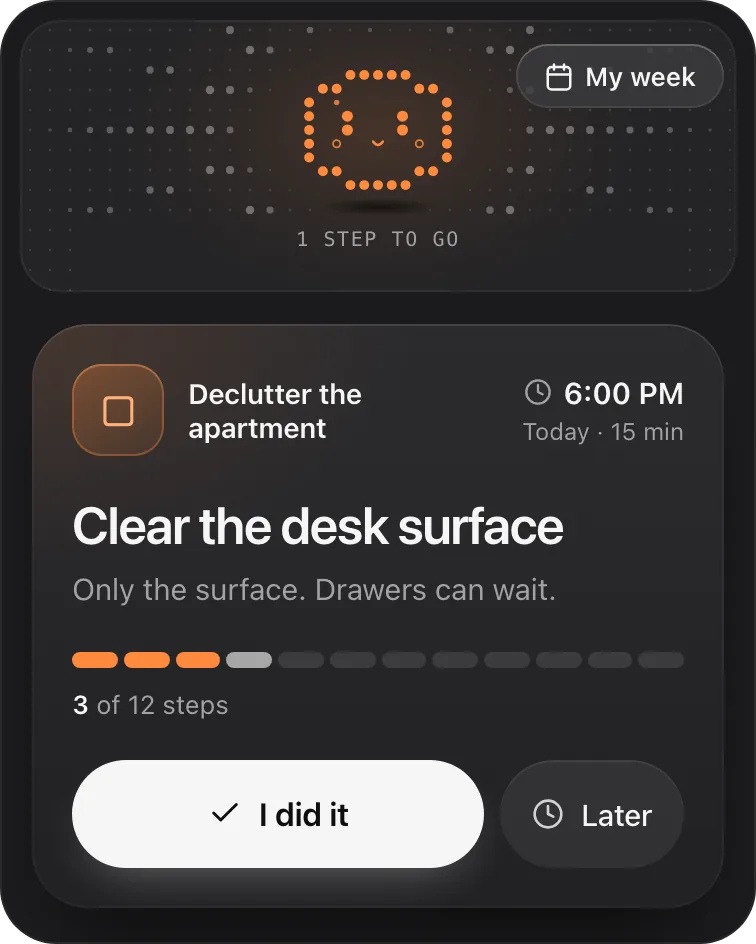
Petipa is an app inside ChatGPT that keeps a plan like this and shows you one small step at a time. ChatGPT helps you make the plan; Petipa remembers it after the chat is closed, and never stores your conversations. Here's how it works:
- Make the plan with ChatGPT, adjust it until it fits your week, then say "save it to Petipa".
- Each day, ask "@Petipa what's my step today?". You see one step with its minutes, and the rest stays out of view.
- Tap I did it when it's done, or Later if today isn't the day. My week shows what's done and what's next this week.
Away for a few days? Nothing is lost, and there's no streak to break. Petipa welcomes you back calmly and you pick up from today. If the plan needs to change, Petipa asks before it changes it.
What it doesn't do: Petipa sends no reminders, so the cue is still yours. A daily alarm that says "ask @Petipa what's my step today?" covers that. Petipa also doesn't make the plan for you or judge how it's going: that part stays a conversation with ChatGPT, and with you.
Petipa is in ChatGPT's plugin directory.
Enter a valid email.That didn't go through. Try again in a moment.
Add to ChatGPTQuestions
How can I be more consistent with ADHD?
Aim for most days instead of every day, keep only today's step in view, and give each step a floor version for low days. After a gap, do today's step with no catching up.
Why is it so hard to stay consistent with ADHD?
Many people with ADHD describe plans that are too big, lists that show everything at once, check-ins nobody starts, and gaps that make returning feel heavy. A plan that handles those four points is easier to keep coming back to.
How do I stick to a plan with ADHD?
Make each step small with minutes on it, look only at today's step, and tie the check-in to a daily cue like an alarm or your morning coffee. When the plan stops fitting, make it smaller rather than pushing harder.
What should I do after I stop for a few days?
Don't count or redo the days you were away. Do today's step, or its floor version, and carry on from there.
Can ChatGPT help me be consistent with ADHD?
It can help you shape the plan: small steps, floor versions, and a check that the plan fits your week. It waits for you to open it, so pair it with your own cue, like a phone alarm or, depending on your plan, a scheduled task.