Morning routine: a simple one you can keep
A short morning routine built from steps you already do, with minutes on each one, sample routines for different mornings, a lighter version for the bad ones, and a way back after a week off.
The short answer
A good morning routine is three to five steps you do in the same order, each with a rough number of minutes, that fit the time you really have. Build it from things you already do, add one new step at a time, keep a two-minute version for bad mornings, and after a week off, start again from step one.
What a morning routine is, and what it isn't
A morning routine is a short, fixed order for the first part of your day. The point isn't to do more before work. It's to stop deciding: you get up and the next step is already chosen.
Many morning routine guides start with a long list of ideas: water, stretching, journaling, a walk, a cold shower, reading, planning. Each one may be fine. Doing all of them every day is a second job, and a routine that's too big is usually the first one dropped.
So this page starts from the other end: the time you have, the steps you already do, and the smallest version that still counts.
How to build a morning routine, step by step
- Count your real minutes. Take the time you have to leave the house or start work, and subtract the time you usually get up. That's your budget. If it's 40 minutes, the routine fits in 40 minutes, not in the 90 you wish you had.
- Write down what you already do. Shower, coffee, getting dressed, feeding a pet. These are your first steps: they already happen, so the routine starts from something that works.
- Put them in one order, with minutes. Write each step as a verb and a time: "Shower and dress, 15 min". Add up the minutes. If the total is over your budget, cut or shorten a step before you add anything.
- Add one new step, small. Pick the one thing you most want your mornings to hold, like a short walk or five minutes to plan the day, and add only that. Make it short enough to do on a tired day.
- Keep it for two weeks before you change it. Adjust the minutes to what really happens. Add a second new step only once the first feels automatic.
- Write a light version. Two or three steps that take a few minutes in all. That's what you do on a bad morning, and it still counts.
One thing helps more than any single step: preparing the night before. Clothes picked, bag packed, keys in one place, the coffee ready to start. Each one is a decision you don't have to make half awake.
Morning routine ideas
Pick from these, don't collect them. One or two new ideas are plenty for a first routine.
| Area | Ideas | Minutes |
|---|---|---|
| Getting up | Same wake-up time on workdays, open the curtains, make the bed | 2 to 5 |
| Body | A glass of water, stretching, a short walk outside | 2 to 15 |
| Getting ready | Shower, dress, breakfast, pack the bag | 15 to 30 |
| Home | Start the dishwasher, a five-minute tidy of one surface, water the plants | 5 |
| Mind | A few lines in a notebook, reading a few pages, a quiet coffee before the phone | 5 to 15 |
| The day | Look at today's calendar, pick the one task that matters most | 5 |
The phone is worth one decision of its own. Many people find a morning goes better when the first screen they open is the plan for the day, or nothing at all, rather than messages and feeds.
Sample morning routines
Four mornings, each with a total. Use one as a template and change the steps to yours.
A 20-minute workday morning
| Step | Minutes |
|---|---|
| Get up at the same time, open the curtains | 2 |
| Shower and dress (clothes picked the night before) | 10 |
| Coffee and breakfast, phone face down | 5 |
| Look at today's calendar and pick the one task that matters most | 3 |
A 45-minute morning with room for one habit
| Step | Minutes |
|---|---|
| Get up, glass of water, make the bed | 5 |
| A short walk outside or stretching | 15 |
| Shower and dress | 15 |
| Breakfast | 5 |
| Plan the day: one main task and when you'll do it | 5 |
A school morning with kids
| Step | Minutes |
|---|---|
| Get up before the kids and get dressed | 10 |
| Wake the kids, breakfast together | 15 |
| Teeth, shoes and coats (bags packed the night before) | 10 |
| Check the day: pickups, after-school plans, what's for dinner | 5 |
A work-from-home morning
| Step | Minutes |
|---|---|
| Get up at a set time, even with no commute | 2 |
| Dress for the day, not in what you slept in | 10 |
| Breakfast away from the desk | 10 |
| A five-minute walk around the block, as a "commute" | 5 |
| Open the plan for the day before opening email | 3 |
A morning routine checklist you can copy
A blank template to fill in. Copy it into a note or print it, then cross off each line as you go:
| Step | Minutes | Done |
|---|---|---|
| 1. | ||
| 2. | ||
| 3. | ||
| 4. | ||
| 5. | ||
| Total | ||
| Light version: |
Keep it where you'll see it in the morning: on the fridge, by the coffee maker, or as the first note on your phone.
The light version for bad mornings
Some mornings start late, after a bad night, or with no energy at all. The full routine won't fit, and skipping it entirely makes the next day harder to start.
Write a light version now, while it's easy to think: two or three steps, a few minutes in all. For example:
- Glass of water
- Get dressed
- Look at the one task for today
That's it. On a bad morning you do the light version and call it done. Many people find that keeping the habit of starting the routine matters more than finishing all of it.
When time runs short, cut from the end of the list, not the start. The first steps carry the rest.
How to restart a morning routine after a week off
A trip, an illness, a new job or a busy stretch can stop a routine for days or weeks. Starting again is where many routines quietly end, often because restarting feels like admitting it didn't work.
- Don't make up for the days off. There's nothing to catch up on in a morning routine. Tomorrow is just a morning.
- Start with the light version for a few days. It's easy to do, and it rebuilds the order before the minutes.
- Check whether the routine still fits. If your mornings changed, the routine should change too. A new wake-up time or a new commute means new minutes.
- Go back to the full version once the light one feels normal again.
A routine that you come back to after a gap is a routine that works. If keeping things going is the hard part in general, how to be consistent with ADHD has a restart rule that fits any plan.
From a morning routine to a daily routine
Once mornings feel steady, the same shape works for the rest of the day. A daily routine template for adults can be four short blocks:
| Block | What goes in it | Minutes |
|---|---|---|
| Morning | Your morning routine | 20 to 45 |
| Midday | Lunch away from the screen, a short walk, check the plan | 10 to 30 |
| After work | One home task, then a clear end to the workday | 15 to 30 |
| Evening | Prepare tomorrow: clothes, bag, keys, the first task | 10 |
The evening block is the one that holds the morning together. Ten minutes of preparing tomorrow takes a handful of decisions out of a morning when you're least ready to make them. For the plan inside the day, see how to use ChatGPT as a daily planner.
If the after-work home task keeps changing, a cleaning schedule with one area a day decides it for you.
Make your own morning routine with ChatGPT
Many people who plan with ChatGPT tell it everything at once, then ask it to cut the plan down until it fits. For a morning routine:
Help me build a morning routine. I get up at [time] and need to
leave or start work at [time]. Things I already do in the
morning: [list]. One thing I'd like to add: [habit].
Give me three to five steps in order, each with minutes, that
fit in the time I have. Then give me a light version of two or
three steps for bad mornings. Put it in a table.
If your mornings have changed:
My morning routine stopped working. It was: [paste it]. What
changed: [new wake-up time, new job, kids, etc.]. Rewrite it to
fit my mornings now, and cut anything that doesn't fit.
On a bad morning:
I'm running late and low on energy. What's the shortest version
of my morning routine I can do in five minutes?
Check the result against the time you really have, and keep it smaller than ChatGPT suggests if in doubt. Then close the chat and start step one.
How Petipa helps with a morning routine
A routine on a list works until the morning you don't look at the list. A routine in a chat scrolls away, and a week later you're back to deciding each morning what to do first.
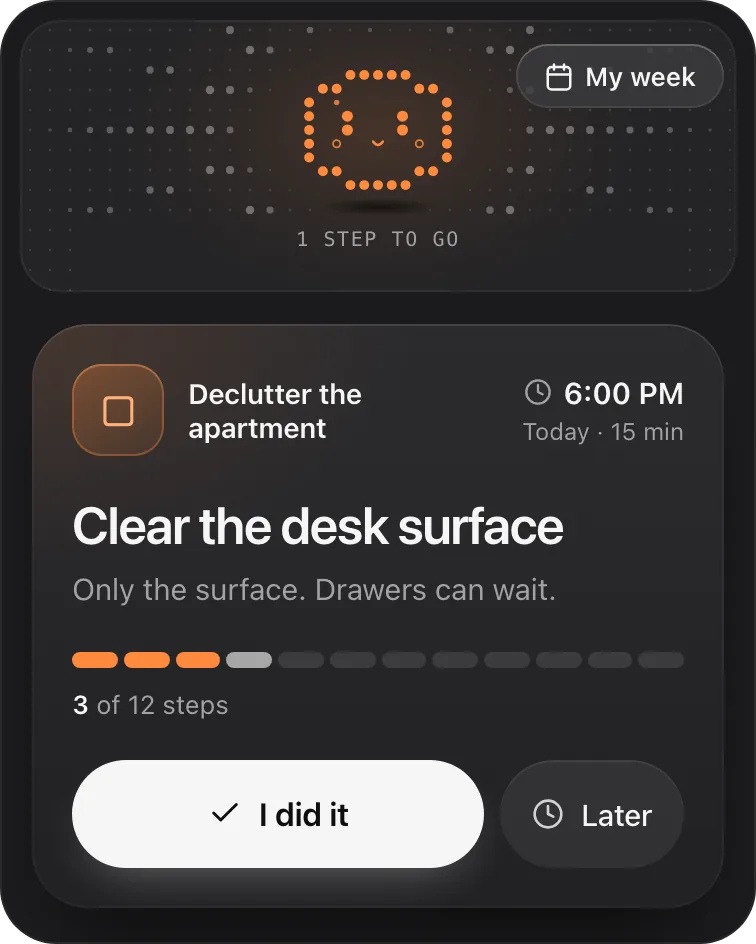
Petipa is an app inside ChatGPT that keeps a plan like this and shows you one small step at a time. ChatGPT helps you build the routine; Petipa remembers it after the chat is closed, and never stores your conversations. Here's how it works:
- Build your morning routine with ChatGPT, adjust it to your mornings, then say "save it to Petipa".
- Each morning, ask "@Petipa what's my step today?". You see one step with its minutes, like "Plan the day: one main task, 5 min".
- Tap I did it when it's done, or Later if today isn't the day. My week shows what's done and what's next this week.
A week away from the routine? Nothing is lost. Petipa welcomes you back calmly and you pick up from today. If the routine needs to change, like a new wake-up time, Petipa asks before it changes the plan.
What it doesn't do: Petipa doesn't wake you up or sync with a calendar, and it sends no reminders, so you start the check-in yourself. Some people put it in the routine itself: the alarm that wakes them says "ask @Petipa what's my step today?".
Petipa is in ChatGPT's plugin directory.
Enter a valid email.That didn't go through. Try again in a moment.
Add to ChatGPTQuestions
What is a good morning routine?
One that fits the time you really have and that you still do on a tired day. Three to five steps in a fixed order, each with minutes, built mostly from things you already do, with a light version for bad mornings.
How long should a morning routine be?
As long as the time between getting up and leaving or starting work allows. For many people that's 20 to 45 minutes. A short routine you keep beats a long one you drop.
What should I put in my morning routine?
Start with what you already do, like getting dressed and breakfast, then add one thing you want your mornings to hold, such as a short walk or five minutes to plan the day. Add more only once that feels automatic.
How do I build a morning routine that actually sticks?
Make it small, keep the same order, and prepare the night before. Write a light version for bad mornings, and after a gap, restart with the light version instead of making up for the days off.
Do I need to wake up early for a morning routine?
No. A morning routine starts whenever your morning does. What matters is a steady order that fits your time, not a particular hour.
What's the difference between a morning routine and a daily routine?
A morning routine covers the first part of the day. A daily routine adds short blocks for midday, after work and the evening, often including ten minutes to prepare the next morning.
Is there a morning routine template I can print?
Yes. Copy the checklist on this page into a document and fill in your steps, minutes and light version, or ask ChatGPT to make one for your mornings in a table you can print.
Can ChatGPT make me a morning routine?
Yes. Tell it when you get up, when you need to leave, what you already do and one thing you'd like to add, and ask for three to five steps with minutes plus a light version for bad mornings.