How to build a habit that sticks
Six plain steps to build a habit you still have in two months: a tiny first version, a cue you already have, a light version for bad days, and a way back after a gap that doesn't send you to day one.
The short answer
To build a habit, start smaller than feels useful, like two minutes, and attach it to something you already do every day. Decide a light version for hard days before you need it. Skip a day and carry on the next, with no catching up. Grow it only once it feels easy.
Why most new habits don't last
Most habits don't end because the person didn't want them enough. They end for plainer reasons:
- The first version is too big. An hour at the gym or 30 minutes of reading works on a free Saturday and not on a Tuesday.
- There's no set moment for it. "Every day" with no time attached slides to later, then to tomorrow.
- A bad day has no version. When the full habit doesn't fit, nothing gets done, and that feels like losing ground.
- A gap feels like the end. After a few days off, starting over from day one feels too heavy, so people don't start at all.
Each step below answers one of these.
How to build a habit, in six steps
1. Pick one habit, and say it as an action
Choose one habit for now, not five. Write it as something you do, not something you are: "walk after lunch" rather than "be more active", "read one page in bed" rather than "read more". A clear action is done or not done, so you know when today counts.
2. Start smaller than feels useful
Make the first version so small it feels almost silly: two minutes, one page, one push-up, shoes on and out the door. The point at the start isn't the result. It's showing up at the same moment often enough that it stops being a decision.
If you're unsure, ask: "Could I do this on my worst day of the week?" If not, cut it in half.
3. Tie it to something you already do
A habit needs a moment. The easiest one is a thing you already do every day without thinking: coffee, brushing your teeth, sitting down at your desk, closing the laptop. Then write it as one line:
After I [something I already do], I will [the new habit].
- After I pour my morning coffee, I will write one line in my journal.
- After I shut the laptop for the day, I will walk around the block.
- After I brush my teeth at night, I will read one page.
This is often called habit stacking. Pick an anchor that happens on busy days too, not only good ones.
4. Make it easy to start
Take away one small obstacle before you need to: shoes by the door, the book on the pillow, the water bottle on the desk, the app on the first screen. Every step between you and the habit is a chance to put it off. Put the first step within reach of the anchor.
5. Decide the light version now
Every habit needs a version for hard days, decided in advance so you don't have to bargain with yourself in the moment:
| Habit | Normal | Light version |
|---|---|---|
| Walking | 15 minutes after lunch | To the end of the street and back |
| Reading | 10 pages in bed | One page |
| Journaling | Five minutes after coffee | One line |
| Working out | A 20-minute routine | One round of the first exercise |
| Tidying | 10-minute evening reset | Dishes only |
The light version counts. A day with the light version is a day the habit happened.
6. Restart after a gap without starting over
You'll skip days. Everyone does. What matters is the rule you have for the next day:
- Carry on the next day. Don't wait for Monday or the first of the month.
- Don't catch up. Doing two days' worth tomorrow makes tomorrow harder. Do the normal step, or the light one.
- Try not to skip two in a row. One skipped day is nothing. If you notice two, do the light version on the third, whatever the day looks like.
- After a week or more away, come back with the very first, smallest version for a few days, then return to where you were.
- If it keeps falling off, the habit is probably too big or tied to a moment that doesn't happen reliably. Shrink it or move it, instead of trying harder.
How to make a habit stick once it's started
- Grow it slowly. Add a little only once the current size feels easy for a week or two: 10 minutes becomes 12, not 30.
- Notice that you did it. A tick in a note, a quiet "done". Some people like a tracker; if a blank square makes you want to quit, skip the tracker.
- Keep one habit in progress at a time. Add the next one once the first runs on its own.
- Check in once a week. Did it fit? What got in the way? Should the time, the size or the anchor change?
How long does it take to build a habit?
Longer than the often-quoted 21 days, for many people, and it varies a lot. Research on simple daily habits suggests it often takes around two months for one to feel automatic, with some people much faster and others much slower. A harder habit usually takes longer than an easy one. The same research found a single skipped day made little difference, which is one more reason not to start over after one.
So don't measure the habit by a number of days. Measure it by how much effort it takes. When you do it without having to talk yourself into it, it's working.
How to build habits with ADHD
Many people with ADHD describe the same pattern: a new habit feels exciting for a week or two, then the novelty fades and it drops off, and a gap feels like proof it didn't work. A few things people find help:
- Keep the first version tiny, even smaller than the steps above suggest.
- Use a cue you can see or hear, like the book on the pillow or an alarm you set yourself, not a cue you have to remember.
- Change the setting, not the habit, when it gets dull: a new route for the walk, a different room for reading.
- Plan for the restart as part of the habit, not as a sign it didn't work.
How to be consistent with ADHD goes further into most-days consistency, floor versions and restarting with no catch-up.
Habit ideas to start with
| Area | A habit | The first version |
|---|---|---|
| Movement | A daily walk | 5 minutes after lunch |
| Working out | A short home workout | 5 squats after brushing your teeth |
| Mornings | A calmer start | A glass of water before the phone |
| Home | An evening reset | Clear one surface after dinner |
| Learning | A language | Five words after coffee |
| Reading | Reading before bed | One page |
| Money | Tracking spending | Note today's biggest purchase at night |
| Work | Planning tomorrow | Write tomorrow's first task before you log off |
To string a few of these into a morning, see the morning routine guide. To try one for a month first, a 30 day challenge is a good test.
Build a habit with ChatGPT
ChatGPT can help you size a habit to your real week. Copy this and fill in the brackets:
Help me build one habit.
The habit: [walking / reading / journaling].
Why I want it: [more energy in the afternoon].
Something I already do every day that it could follow:
[my morning coffee / shutting the laptop].
Time I really have on a busy day: [5] minutes.
Give me: the smallest first version, an "After I..., I will..."
line, one obstacle to remove tonight, a light version for hard
days, and when to grow it. Keep it short.
After a gap:
I was building a habit of [walking after lunch] and I've
skipped the last [5] days because [work got busy].
Don't make me catch up or start over. Give me the smallest
version for the next three days, and tell me if the habit or
its moment should change.
ChatGPT tends to agree with what you ask for, so if your plan looks heavy, ask it: "What about this is too much for a busy week?"
How Petipa helps you build a habit
The first week is easy. Week three is where habits fade: the plan you made in a chat scrolls out of sight, and after a few busy days it's hard to know where you were.
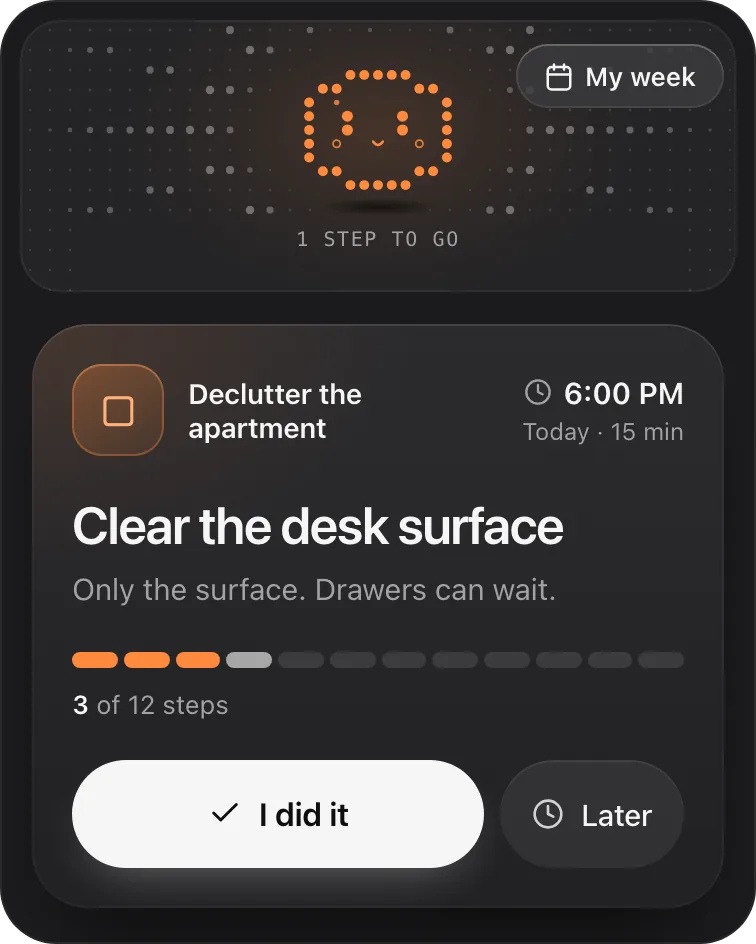
Petipa is an app inside ChatGPT that keeps a plan like this and shows you one small step at a time. ChatGPT helps you shape the habit; Petipa remembers it after the chat is closed, and never stores your conversations. Here's how it works:
- Build your habit plan with ChatGPT, then say "save it to Petipa".
- Each day, ask "@Petipa what's my step today?". You see one step with its minutes, like "Walk around the block after work, 10 min".
- Tap I did it when it's done, or Later if today isn't the day. My week shows this week's steps: what's done and what's next.
Away for a few days? Nothing is lost. Petipa welcomes you back calmly and you pick up from today, with nothing to make up. If you want to grow the habit or make it smaller, ask in ChatGPT, and Petipa asks before it changes the plan.
What it doesn't do: Petipa isn't a habit tracker. It shows no streaks or chains to protect, and it sends no reminders, so your anchor or an alarm you set starts the check-in. Some people set a daily phone alarm that says "ask @Petipa what's my step today?".
Petipa is in ChatGPT's plugin directory.
Enter a valid email.That didn't go through. Try again in a moment.
Add to ChatGPTQuestions
How do you build a habit?
Pick one habit, start with a version of two minutes or so, and tie it to something you already do every day ("After I pour my coffee, I will..."). Decide a light version for hard days, carry on after a skipped day without catching up, and grow it only once it feels easy.
How do I make a habit stick?
Keep it small, give it a fixed moment, remove one obstacle before you need to, and have a light version that still counts. When it keeps falling off, shrink it or move it to a more reliable moment instead of trying harder.
How long does it take to make a habit stick?
It varies a lot by person and habit. Research on simple daily habits suggests it often takes around two months to feel automatic, longer than the often-quoted 21 days, and a single skipped day makes little difference.
What is habit stacking?
Habit stacking means tying a new habit to one you already have, in one line: "After I [current habit], I will [new habit]." The existing habit becomes the cue, so you don't have to remember the new one.
What should I do if I skip a day?
Carry on the next day with the normal step or the light version. Don't do double to catch up, and don't restart from day one. If you're away a week or more, come back with the smallest version for a few days.
How do you build habits with ADHD?
Many people with ADHD find it helps to keep the first version tiny, use a cue they can see or hear, change the setting when the habit gets dull, and plan the restart in advance as part of the habit.
Can ChatGPT help me build a habit?
Yes. Tell it the habit, why you want it, something you already do every day, and the time you have on a busy day, and ask for a tiny first version, an "After I..., I will..." line, a light version and when to grow it.