ADHD paralysis: what it is and how to get out of it
What many people mean by ADHD paralysis, what tends to set it off, and how to get unstuck: one task, one tiny first step, and a restart with nothing to catch up.
The short answer
ADHD paralysis isn't a diagnosis; it's a term many people use for freezing before a task, even one they want to do. To get out of it, pick one task with a single rule, shrink it to a first step you could do in two minutes, set a short timer, and put everything else out of view.
What is ADHD paralysis?
ADHD paralysis is the stuck feeling of knowing what you need to do, wanting to do it, and still not being able to start. You open the laptop and scroll. You look at the list, and nothing moves. An hour later you're tired, and the task hasn't begun.
It isn't a medical term or a diagnosis. It's an everyday phrase many people with ADHD use for this freeze, and you'll also hear task paralysis or ADHD freeze. You don't need a label for the steps on this page to help.
It also isn't a lack of caring. Many people who describe it care a lot about the task, and that can make the freeze feel heavier, not lighter.
Task paralysis, decision paralysis and too much at once
When people talk about ADHD paralysis, they usually mean one of three things, and they often mix:
| What people call it | What it feels like | Where to start |
|---|---|---|
| Mental paralysis | So many tasks, thoughts and worries at once that nothing gets through | Get it all out of your head onto one page |
| Decision paralysis | Too many options, so you can't pick which comes first | Let one rule decide |
| Task paralysis | One task you can't begin, often a big, vague or dull one | Shrink it to a first physical step |
The method below takes them in that order: empty your head, let a rule choose, then shrink the choice to one step.
What sets it off
Many people with ADHD describe the same few triggers:
- Too many tasks in view. Every task competes with every other one, so choosing feels like work before the work.
- A first step that isn't clear. "Do the taxes" isn't something you can do. It's a project.
- A task that feels too big or too dull. Big tasks have no obvious way in, and dull ones give you nothing to pull you along.
- Worry about doing it wrong. If the result has to be good, starting means risking a bad start.
- A gap. After a few days away, the pile looks bigger, and coming back feels like starting from zero.
Every step below takes aim at one of these.
How to get out of ADHD paralysis right now
If you're stuck at this moment, skip the reading and try this:
- Stand up, get a glass of water, or walk around the room for one minute. Moving first helps some people shift out of the freeze.
- Pick the task that's nearest, on your desk or at the front of your mind. Don't weigh it against the others.
- Do the very first thing your hands would do: open the file, pick up one item, write one sentence.
- Then decide whether to keep going. Stopping now still counts.
The rest of this page is the full method, for when you have five minutes.
How to start a task when ADHD paralysis hits: five steps
1. Empty your head (2 minutes)
Write down everything you're carrying: tasks, errands, worries, half-ideas. Don't sort and don't judge. You're only moving the list from your head to paper, so it stops taking up space.
2. Choose one task with a single rule
Don't weigh all of them against each other. Pick a rule and let it decide:
- Soonest deadline wins, or
- Smallest task wins, if you need momentum, or
- The task that unblocks others wins (the email that someone is waiting on).
One rule, one task. The rest can wait. You'll still have them on the list from step 1.
3. Shrink it to the first physical step
This is the step that does most of the work. Turn the task into the very first thing your hands would do, starting with a verb, small enough to do in about two minutes. You can't do a project, only the next action in it.
| The task | The first physical step |
|---|---|
| Clean the apartment | Clear the kitchen counter |
| Do my taxes | Find last year's tax return |
| Write the report | Open a document and type the title and three headings |
| Start running | Put on your running shoes and step outside |
| Sort out my inbox | Answer the oldest email that takes under two minutes |
| Apply for jobs | Rewrite the first line of your résumé |
If the first step still feels heavy, shrink it again. "Find last year's tax return" can become "open the drawer where papers go".
4. Set a short timer
Give yourself 10 or 15 minutes, and permission to stop when it rings. Aim for time, not for done: "ten minutes on the report" is easier to begin than "finish the report", and stopping after 10 minutes still counts as starting.
Often you'll keep going. If you don't, you've still moved.
5. Put everything else out of view
Close the other tabs. Turn the list face down. Leave on the screen only the step you're doing. The other tasks aren't gone. They're waiting, out of view, until this step is done.
ADHD task paralysis tips that help many people
The five steps work for anyone. These extras help many people with ADHD get going:
- Make the first step visible. Write it on a sticky note, or put the tool for it in front of you: the running shoes by the door, the document already open.
- Start with the part you like. Order doesn't always matter. If one part of the task is interesting, start there.
- Work alongside someone. A friend on a call, a library, a café. Many people call this body doubling: being next to someone working can make it easier to begin.
- Use the same start every time. A drink, one song, then the timer. A small routine marks the moment work begins.
- Plan a small reward. "When I've sent the email, I'll make tea." A when-then deal gives the start a clear finish.
- Change the place. Moving to another room, or out of the house, can break the loop.
- Talk to yourself kindly. Calling yourself names doesn't start anything. "This is a hard start, and one small step is enough" works better.
Use ChatGPT to find the first step
Many people who plan with ChatGPT use it this way: not for a whole plan, but for a way in. An opening move, a messy draft to fix rather than an empty page, or one quick win to get the day going. When everything blurs together, paste your list from step 1:
I'm stuck and can't start anything. Here's what's on my mind: [your list].
Using the rule "[soonest deadline / smallest task / unblocks others]",
pick ONE task for me. Then give me its first physical step, small enough
to do in two minutes, starting with a verb. Nothing else.
When the first step still feels too big:
That step still feels too big. Make it smaller. Keep it physical,
and start with a verb.
When you can't choose between two or three things:
I can't choose between these: [options]. Pick one for me and give
me one reason. Don't list pros and cons.
Ask for fewer steps, not more. Many people find that a breakdown into lots of tiny steps just becomes one more long list to look at. If you want to see a few steps ahead, cap it:
Break this into no more than three steps, and show me only the first.
Then close the chat and do the step. Talking a task through can feel like progress while the task waits. If you'd rather not use ChatGPT at all, everything on this page works on paper too. Our guide ChatGPT for ADHD has more copy-paste prompts.
On low days, lower the bar
Some days even a two-minute step feels like too much. That's the day for the smallest version that still counts:
- Instead of "clean the kitchen": put three things in the dishwasher.
- Instead of "write the report": open it and read the last paragraph.
- Instead of "go for a run": put on your shoes and walk to the corner.
ChatGPT can find that version for you:
My energy is low today. What's the smallest version of this task
that still counts? Give me only that.
A small step on a low day is still a step. It keeps the task warm for tomorrow.
After a gap: restart with nothing to catch up
Many people describe the hardest freeze as the one after a few days away. The list has grown, and starting again feels like starting from zero. Two habits make the return smaller:
- Start from today. Don't try to make up the days you were away. Pick today's one step and do only that. Re-sort the rest later, or let some of it go.
- Leave yourself a note. Before you stop any session, write one line naming the next tiny step, such as "Next: reply to the landlord's email", where you'll see it when you come back.
If the task lives in ChatGPT, ask for today's step instead of a new plan:
I stopped working on this a few days ago. Here's where I was:
[what's done, what's left]. Don't plan the whole thing again.
Give me one step for today, 15 minutes or less.
For a plan shape that survives gaps, see how to be consistent with ADHD.
When the freeze comes from too much at once, ADHD overwhelm covers shrinking what you can see, and ADHD procrastination covers the tasks you keep putting off.
How Petipa keeps one step in view
Some tasks are bigger than one sitting: a move, a course, getting fit. There, the first step is only day one, and the freeze can come back each morning when you look at the whole plan again.
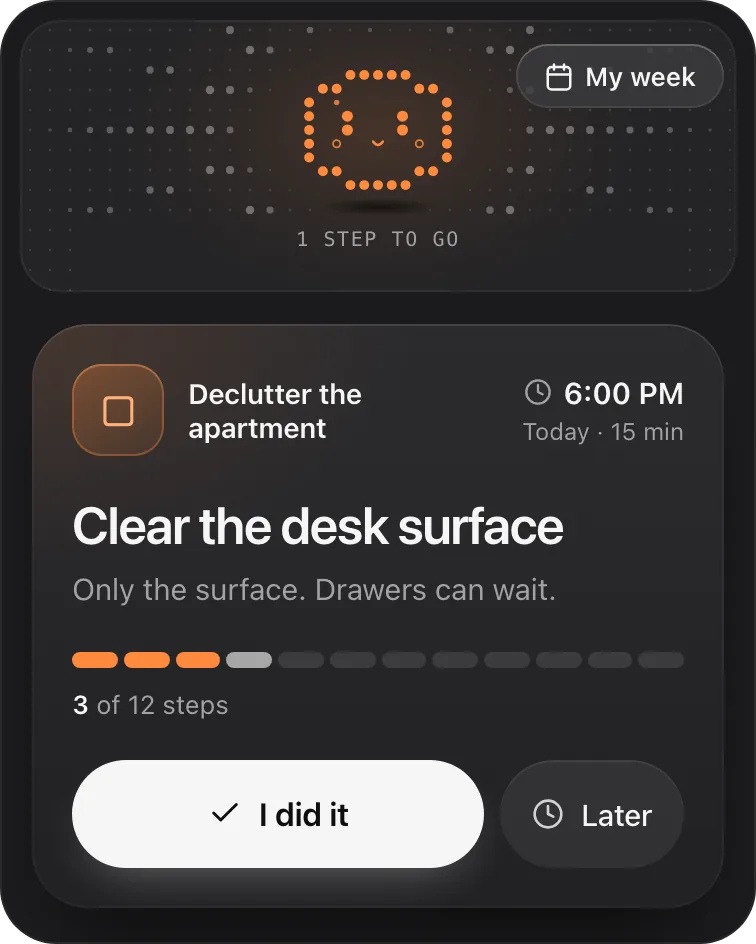
Petipa is built around that. It's an app inside ChatGPT: ChatGPT breaks your plan into small steps, and Petipa keeps the plan after the chat is closed and shows you only today's step, with its minutes. The rest waits, out of view. Petipa never stores your conversations. Here's how it works:
- Ask ChatGPT to turn your goal into a plan of small steps, then say "save it to Petipa".
- Each day, ask "@Petipa what's my step today?".
- Tap I did it when it's done, or Later if now isn't the moment. My week shows what's done and what's next, when you want the bigger picture.
Away for a few days? Petipa welcomes you back, nothing is lost, and you start again from today. If the plan needs to change, ChatGPT proposes it and Petipa saves it only after your yes.
Petipa sends no reminders. If remembering to ask is the hard part, set your own daily phone alarm that says "ask @Petipa what's my step today?".
Petipa is in ChatGPT's plugin directory.
Enter a valid email.That didn't go through. Try again in a moment.
Add to ChatGPTQuestions
Is ADHD paralysis real?
It isn't a medical diagnosis, but the stuck feeling is real to the many people who describe it. You don't need a label to use the steps here: one task, a two-minute first step, and the rest out of view.
How do I get out of ADHD paralysis fast?
Move for a minute, pick the nearest task without comparing it to the others, and do its first physical action, such as opening the file. Then decide whether to keep going. Stopping after one step still counts.
What is task paralysis?
Task paralysis is being unable to begin one particular task, often a big, vague or dull one. Many people get in by shrinking it to a first physical step that takes about two minutes.
Is ADHD paralysis the same as procrastination?
Not quite, as people describe it. Procrastination often means doing something easier instead, while ADHD paralysis feels like being unable to start anything, even things you want to do. The same small-first-step methods help with both.
How can I help someone out of ADHD paralysis?
Ask what the very first step is, and offer to sit with them while they do it. Skip the pep talk and the full list. If they can't choose, offer two options and let them pick one.
What is the two-minute rule?
It's a common productivity idea with two versions. One says that if a task takes under two minutes, you do it right away. The other says to shrink a new habit to a version that takes under two minutes. Both make starting easier.
Can ChatGPT help with ADHD paralysis?
It can do the sorting and shrinking for you. Paste your list, ask it to pick one task and give you a two-minute first step, then close the chat and do it. Ask for fewer steps, not more.
When should I talk to someone about it?
If being stuck gets in the way of work, home or how you feel about yourself most weeks, talk to a doctor or a therapist you trust. The steps on this page are everyday planning help, not care.