ADHD motivation: how to get going when you don't feel like it
Waiting to feel motivated rarely works. Start with a step small enough to need almost none, then add urgency, something new, a challenge or company on purpose.
The short answer
Many people with ADHD describe motivation that shows up for what's interesting, new, challenging or urgent, and not for what's only important. So don't wait to feel motivated. Shrink the first step until it needs very little motivation, then add one of four things on purpose: a deadline, a new place, a challenge or company.
What motivates people with ADHD?
Ask people with ADHD what gets them moving and the answers sound alike: something interesting, something new, something hard in a fun way, or a deadline that's very close. What often doesn't work is knowing a task matters. The bill is important, the email is important, and they still sit there.
Some ADHD coaches sum this up with an acronym, INCUP: interest, novelty, challenge, urgency and passion. You'll also hear people describe themselves as "interest-based" rather than "importance-based". These are coaching words, not a diagnosis, but many people say they match their days well.
Another picture people use is a bridge. Between meaning to do something and doing it there's a gap, and motivation is what gets you across. A task with little interest, newness or urgency leaves a wide gap. Everything below does one of two things: it makes the gap smaller, or it adds something to cross it with.
Low motivation isn't low effort
Struggling to start something you care about isn't a lack of effort or character. Many people with ADHD describe trying hard, still not starting, and then spending the rest of the day criticizing themselves for it. You'll hear from ADHD coaches that shame doesn't get anyone moving, and it tends to make the next start harder.
A more useful question than "why can't I just do it?" is "what's missing from this task right now?" Usually the step is too big, or the task has nothing pulling you in. Both can be fixed on purpose.
How to get motivated with ADHD: one small step, then one thing added
1. Make the first step small enough to need almost no motivation
The less a step asks, the less motivation it takes to begin. "Do my taxes" asks a lot. "Find last year's tax form and put it on the table" asks very little.
Shrink the first step until it is:
- physical: open, find, write, put, call
- short: a few minutes
- clear: you know exactly where to begin
Then give yourself permission to stop after it. Stopping after the first step still counts. Often the next step feels easier once you've started; when it doesn't, you've still moved. Our guide on how to start a task goes deeper on finding that step.
If the step is small and you still can't start, add one of the four things below. Pick one, not all four.
2. Add urgency: a deadline you set
Many people with ADHD describe doing their best work the night before something is due. You can borrow some of that pressure without waiting for the last night:
- Pick a time, not a day: "at 4 pm", not "this afternoon".
- Set your own deadline, earlier than the real one, and tell someone about it.
- Race a timer: how much can you do in 15 minutes?
3. Add novelty: change one thing
A dull task can feel new again with a single change:
- Change the place: another room, the kitchen table, a café, a library.
- Change the order: start with the easiest part, or in the middle.
- Change the format: talk it through out loud, use pen and paper instead of the laptop.
Newness wears off, so expect to switch again in a week or two. That's normal, not a sign the method stopped working.
4. Add a challenge: make it a game
- Beat the clock: set a timer and try to finish before it rings.
- Set a count: "ten emails, then I stop".
- Keep score: a tally mark for each thing put away.
5. Add company: someone nearby, or someone to tell
Many people find it easier to start when someone else is there. Some call this body doubling: working next to someone, in person or on a video call, each on your own thing. Lighter versions work too:
- Text a friend what you'll do and by when, then text again when it's done.
- Declare and report back: tell ChatGPT what you're about to do, do it, then come back and say "done, what's next?".
If you can, borrow some interest
Interest is the hardest of these to add on purpose, but you can attach a little to a task that has none:
- Pair it with something you like: a podcast only for folding laundry, one playlist only for email.
- Name the reason in one line: "I'm booking the car service so the trip is easy."
- Reward yourself right after, not at the end of the week.
When you have no motivation to do anything
Some days nothing feels doable. On those days, lower the bar instead of pushing harder:
- Pick one task and its smallest version that still counts: one plate washed, one email answered, one shirt folded.
- Do just that, and let it count as a day with something done in it.
- Let the rest wait, without moving all of it onto tomorrow's list.
Good enough beats perfect on a low day. If nothing has felt worth doing for weeks, it's worth talking to a doctor.
Use ChatGPT to find a step you can start
ChatGPT is good at the two things that are hardest when motivation is low: making a step smaller, and adding a little pull to it. Copy this, fill in the brackets, and send it as one message:
I need to do [task], and I have no motivation for it.
I have [minutes] and I'm at [place].

1. Give me a first step I can start in 2 minutes. Make it physical
   and concrete. Only the first step.
2. Suggest one way to make it easier to start, using only one of
   these: a deadline I set, a change of place, a small challenge,
   or company.
3. Keep your answer under 80 words. No pep talk.
For a dull task, ask for a game:
Turn [task] into a short challenge I can do in 15 minutes.
Give me one rule and one way to keep score. Under 60 words.
For a low day:
My energy is very low today. What's the smallest version of
[task] that still counts? One step, under 10 minutes.
Then close the chat and do the step. ChatGPT tends to agree with whatever you ask, so if a step still feels too big, say so and ask for a smaller one. And watch for the trap many people describe: talking a task through can feel like progress while the task itself doesn't move. If the chat is taking longer than the step, stop typing and start.
Getting going again after a gap
Motivation often drops after a break: a sick week, a trip, a few days where nothing happened. The return is where many plans end, because a pile of waiting tasks makes restarting feel bigger than starting.
- Don't catch up. Start from today's step as if the gap were normal, because it is.
- Pick the smallest step, not the one that's been waiting longest.
- Expect the first day back to feel slow. One step is a full restart.
If the plan lives in a chat, ask:
I stopped working on [goal] for [number] days. Don't list what I
didn't do. Give me one step for today, under 15 minutes, that
gets me going again.
There's more on plans that survive gaps in how to be consistent with ADHD. And if the task you can't start is buried in a pile of others, a brain dump can clear the view first.
How Petipa helps when motivation is low
The methods above work with ChatGPT alone. What a chat doesn't do on its own is keep your place in a plan from one day to the next: ChatGPT's memory, when it's on, keeps relevant details, not every detail of every conversation. So each low morning can start with explaining everything again. Petipa is an app inside ChatGPT that keeps the plan once you've made it, and it never stores your conversations. Here's how it works:
- Make a plan in ChatGPT, adjust it until the steps feel small enough, then say "save it to Petipa".
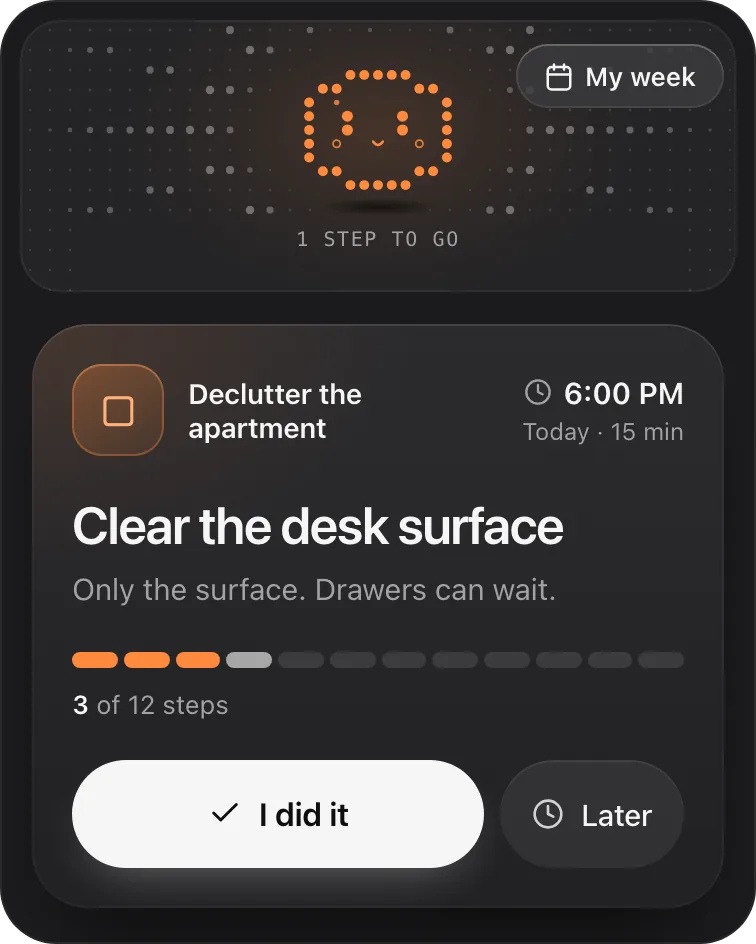
- When you're ready, ask "@Petipa what's my step today?" You see one step with its minutes, not the whole list.
- Tap I did it when it's done, or Later if now isn't the moment. My week shows what's done and what's coming up.
Away for a few days? Nothing is lost. Petipa welcomes you back, and you start again from today. If the plan needs to change, ChatGPT proposes it and Petipa saves it only after your yes.
What it doesn't do: Petipa doesn't add the deadline, the challenge or the company for you, and it sends no reminders, so you still start the check-in yourself. A phone alarm that says "ask @Petipa what's my step today?" covers that.
Petipa is in ChatGPT's plugin directory.
Enter a valid email.That didn't go through. Try again in a moment.
Add to ChatGPTQuestions
What motivates people with ADHD?
Many people with ADHD say they get going for what's interesting, new, challenging or urgent, more than for what's important. Some coaches sum this up as INCUP: interest, novelty, challenge, urgency and passion.
How do I get motivated with ADHD?
Don't wait for the feeling. Shrink the first step until it takes a few minutes, then add one thing on purpose: a deadline you set, a new place, a small challenge, or someone working alongside you.
What is the ADHD motivation acronym?
INCUP, short for interest, novelty, challenge, urgency and passion. It's a coaching shorthand, not a diagnosis, for the things many people with ADHD say help them start.
What can I do when I have no motivation to do anything?
Pick the smallest version of one task that still counts, do only that, and let the rest wait. If nothing has felt worth doing for weeks, talk to a doctor.
How do I stay motivated with ADHD?
Expect motivation to come and go, and plan for it: keep steps small, change one thing when a method gets stale, and after a gap restart from today's step instead of catching up.
Can ChatGPT help with ADHD motivation?
It can make a step smaller, turn a dull task into a short challenge, and give you a lighter version on a hard day. It can't do the step for you, so get the step and close the chat.