30 day challenge ideas, and how to actually finish one
Thirty-day challenge ideas for movement, mind, home, money, learning, work and the people around you, each with a step for day one, then a plain way to get to day thirty: a small daily step, a light version, and no restart from zero.
The short answer
A 30 day challenge is one small thing you do most days for a month, like a 10-minute walk, five minutes of journaling or one drawer cleared. Pick one, not five. Make day one tiny, decide a light version for hard days, and after a skipped day, carry on from the next day instead of starting over.
What a 30 day challenge is
A 30 day challenge is a short, fixed trial of a habit. Thirty days is long enough to see whether something fits your life, and short enough that it doesn't feel like forever. At the end, you decide: keep it, change it or drop it.
Most lists of 30 day challenge ideas stop at the idea. The hard part is everything after: what you do on day one, how big each day is, and what happens on day nine when you don't do it. This page gives you ideas with a first step for each, then a plan for getting to day thirty.
How to pick a 30 day challenge you'll finish
- One challenge at a time. Two at once feels motivated on day one and heavy by day six. Write the others down for next month.
- A daily step under 15 minutes. If the full version is longer, the challenge is the first 10 minutes of it.
- Something you can do on a bad day. Decide the light version now: the two-minute walk, one line in the journal, one sock drawer.
- A clear "done" for each day. "Walk 10 minutes" is done or not done. "Be healthier" never is.
- A start time you already have. After coffee, after lunch, before bed. A challenge with no time slot slides to tomorrow.
30 day challenge ideas, by area
Each idea has a day-one step, small on purpose, and a light version for hard days.
Movement and fitness
| Challenge | Day one | Light version |
|---|---|---|
| A daily walk | Walk 10 minutes, any pace | Walk to the end of the street and back |
| A short home workout | 5 squats, 5 wall push-ups, a 20-second hold | One round, slowly |
| Stretch every day | Five minutes of easy stretches after waking | One stretch, held for a minute |
| More steps, a little at a time | Take the stairs once, or park farther away | One flight of stairs |
| Run-walk | 10 minutes alternating one minute of jogging and two of walking | A 10-minute walk |
If running is the goal, the couch to 5K plan is a run-walk schedule that already ramps up week by week. If you have a health condition or haven't moved much in a while, check with a professional before a new fitness challenge.
Mind, rest and self-care
| Challenge | Day one | Light version |
|---|---|---|
| Journal five minutes | Write three lines about today | One line |
| No phone for the first 20 minutes of the day | Leave it in another room overnight | No phone until after you've had water |
| Read before bed | Ten pages | One page |
| One calm break a day | Five minutes outside or by a window, no screen | Three slow breaths |
| A screen-off time | Screens off 30 minutes before bed | Screens off 10 minutes before bed |
Home and organization
| Challenge | Day one | Light version |
|---|---|---|
| Declutter one spot a day | One drawer: trash out, things that live elsewhere back | Five things out of the drawer |
| A 10-minute evening reset | Dishes done, counter wiped | Dishes only |
| Make the bed | Make it before leaving the bedroom | Pull the cover up |
| One area clean a day | Bathroom sink and mirror | Sink only |
For the full room-by-room version, see the decluttering checklist or the weekly cleaning schedule.
Money
| Challenge | Day one | Light version |
|---|---|---|
| Track every expense | Write down today's spending in a note | Write down the biggest one |
| A no-spend month on one thing | Pick the thing (takeout, coffee out, online shopping) and write it down | Wait one day before buying it |
| Cook at home | Plan tomorrow's dinner from what's in the fridge | A simple meal from the pantry |
| Cancel one thing a week | List every subscription you pay for | Check one |
Learning and students
| Challenge | Day one | Light version |
|---|---|---|
| A language, 10 minutes a day | Ten words and how to say them | Review yesterday's words |
| Study a little every day | One topic, 20 minutes, notes closed at the end | Ten minutes on the same topic |
| Learn a skill | Watch one beginner lesson and try the first exercise | Rewatch the hard part |
| Write every day | 200 words on anything | One paragraph |
Work and career
| Challenge | Day one | Light version |
|---|---|---|
| One focused block a day | 25 minutes on the most important task, notifications off | 10 minutes on it |
| Inbox to zero by Friday | Archive or answer the ten oldest emails | Five |
| Plan tomorrow before leaving | Write tomorrow's first task | Leave the file open |
| Reach out to one person a week | Write one short message to someone you'd like to stay in touch with | Make a list of names |
Couples, family and friends
| Challenge | Day one | Light version |
|---|---|---|
| One kind thing a day | Tell someone one thing you appreciate about them | A short message |
| Ten minutes of real talk | Ten minutes, phones away, with your partner or a family member | Five minutes at dinner |
| Call someone each week | Pick four people, one for each week | A voice message |
| Something new together | Choose a recipe, a walk or a game for this weekend | Pick the date |
A simple 30 day challenge calendar
A calendar or tracker helps when it shows a month that bends. This is a plain shape that works for any challenge on this page:
| Days | What you do |
|---|---|
| 1 to 7 | The day-one step, every day. Don't add anything yet. |
| 8 to 14 | The same step, or a little more if it felt easy (12 minutes instead of 10). |
| 15 to 21 | Keep it. If it feels heavy, go back to the week-one size. |
| 22 to 28 | Keep it. This is usually where it starts to feel normal. |
| 29 and 30 | Two buffer days: a skipped day earlier in the month goes here. |
| After day 30 | Decide: keep it, change it, or drop it. |
To make a printable 30 day challenge tracker, copy the calendar into a document or spreadsheet, add a row of 30 small boxes, and tick one each day you do the step, full or light. Ticks count; blank boxes don't count against you.
What to do if you skip a day
This is where most 30 day challenges end, not because of the skipped day but because of the rule people give themselves after it. Many people describe a gap as the moment a system stops: the tracker shows a blank square, and starting over from day one feels like too much.
A calmer rule:
- Don't restart from day one. Carry on from where you were. Day nine comes after day eight, even if there was a day off between them.
- Don't double up. Two days of the step tomorrow makes tomorrow harder, and the day after harder still. Do the normal step, or the light version.
- Use the buffer days. The two days at the end of the month are there for this. A month with a few skipped days still counts as a month of the challenge.
- If two or three days go by, make it smaller. That usually means the step is too big for your real weeks, not that you can't do it. Cut it in half and carry on.
- Away for a week? Pick up with the day-one step, then return to where you were after two or three days.
If the same habit keeps falling off, how to be consistent with ADHD has a restart rule that works for any routine, ADHD or not.
After day 30
Thirty days is a trial, not a promise forever. At the end, ask three questions: did it help, what got in the way, and what size would fit a normal week? Then pick one:
- Keep it as part of your morning routine or your evening, at the size that worked.
- Change it: fewer days a week, a smaller step, a different time.
- Drop it, and take the next idea from your list for next month.
To turn a challenge that worked into a habit that lasts, see how to build a habit.
A bigger goal, like a race, a new language or a cleared-out home, often works better as a longer plan with weekly steps. The 30 day challenge is a good way to test whether you'll show up for it.
Make your own 30 day challenge with ChatGPT
ChatGPT can turn one idea into a month that fits your days. Copy this and fill in the brackets:
Make me a 30 day challenge.
The challenge: [a daily walk / journaling / decluttering].
Why I want it: [more energy in the afternoon].
Time I have most days: [10] minutes, around [after lunch].
Days that are usually hard: [Monday, Thursday].
Rules: one small step a day that I can finish, a light
2-minute version for hard days, the step grows only a little
each week, and the last two days are buffer days.
Put it in a table: day, step, minutes, light version.
When you've skipped a few days:
I'm on day [12] of my 30 day challenge, [a daily walk], and
I skipped the last [3] days because [I was sick / busy].
Don't make me start over or catch up. Give me a smaller step
for the next three days, then tell me how to finish the month.
ChatGPT tends to agree with whatever you suggest, so if it gives you a month that looks heavy, ask it: "What about this plan is too much for a busy week?"
How Petipa helps you finish a 30 day challenge
The idea is easy. Day eleven is hard. In a chat, the plan scrolls out of sight; on paper, a blank square after a busy day can feel like the end of it.
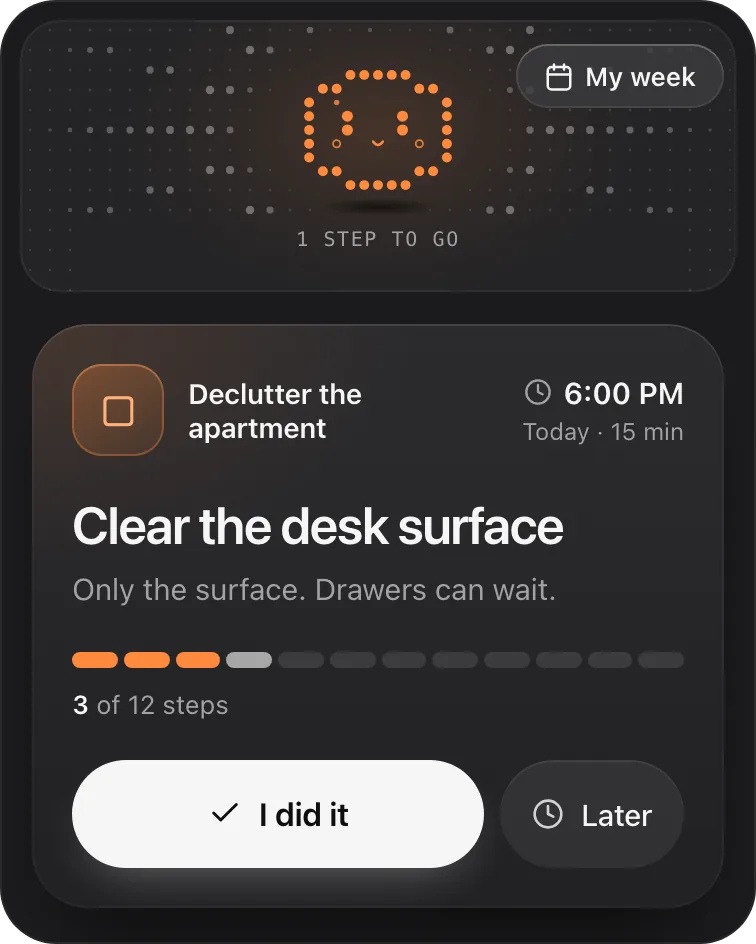
Petipa is an app inside ChatGPT that keeps a plan like this and shows you one small step at a time. ChatGPT helps you build the 30 days; Petipa remembers them after the chat is closed, and never stores your conversations. Here's how it works:
- Build your 30 day challenge with ChatGPT, then say "save it to Petipa".
- Each day, ask "@Petipa what's my step today?". You see one step with its minutes, like "Walk 10 minutes, any pace, 10 min".
- Tap I did it when it's done, or Later if today isn't the day. My week shows this week's steps: what's done and what's next.
Skipped a few days? Nothing is lost. Petipa welcomes you back calmly and you pick up from today, with nothing to make up. If you want smaller steps, ask in ChatGPT, and Petipa asks before it changes the plan.
What it doesn't do: Petipa isn't a printable calendar or a streak counter, it shows no chain of ticks to protect, and it sends no reminders, so you start the check-in yourself. Some people set a daily phone alarm that says "ask @Petipa what's my step today?".
Petipa is in ChatGPT's plugin directory.
Enter a valid email.That didn't go through. Try again in a moment.
Add to ChatGPTQuestions
What is a 30 day challenge?
A 30 day challenge is one small habit you try most days for a month, like a daily walk or five minutes of journaling. At the end, you decide whether to keep it, change it or drop it.
What are good 30 day challenge ideas?
A 10-minute daily walk, five minutes of journaling, no phone for the first 20 minutes of the day, decluttering one spot a day, tracking every expense, 10 minutes of a language, or one kind message a day. Pick the one you'd be glad to have in a month.
What are good 30 day challenge ideas for self improvement?
Journaling, reading ten pages a day, a daily walk, a screen-off time before bed, or one focused block of work a day. Each works best with a small daily step and a light version for hard days.
How do I make a 30 day challenge stick?
Choose one challenge, keep the daily step under 15 minutes, tie it to something you already do, and decide a light version in advance. After a skipped day, carry on from where you were instead of starting over.
Do I have to start over if I miss a day?
No. Carry on from the next day, don't double up, and use two buffer days at the end of the month for any days you skipped. A month with a few gaps still counts.
What is a good 30 day workout challenge for beginners?
Start with a daily 10-minute walk or a short round of squats, wall push-ups and a hold, and grow it only a little each week. Check with a professional first if you have a health condition.
Is there a 30 day challenge calendar or tracker I can print?
Copy the calendar on this page into a document or spreadsheet, add 30 small boxes, and tick one each day you do the step, full or light. Or ask ChatGPT for a version fitted to your challenge.
Can ChatGPT make a 30 day challenge?
Yes. Tell it the challenge, the time you have, the days that are usually hard, and ask for one small step a day, a light version and two buffer days, in a table.