ADHD procrastination: how to start the things you keep putting off
Why putting things off can feel different with ADHD, in the words many people use, and ways to start before the deadline does it for you.
The short answer
Many people with ADHD describe procrastination as waiting for urgency: a task that feels too big, unclear or dull won't start until a deadline is close. What helps is a small, concrete first step, a set time for it, a deadline of your own, and a restart after a gap with no catching up.
What people mean by ADHD procrastination
Everyone puts things off. "ADHD procrastination" is the term many people with ADHD use for a pattern they describe as stronger and more frequent: tasks they care about get pushed to the last minute again and again, even when they know exactly what to do and want it done.
It's a description people use, not a diagnosis, and this page doesn't go into causes or treatment. It's about getting a task started. If putting things off is affecting your work, money or relationships, a professional who knows ADHD can help you look at the bigger picture.
Why it can feel different, as many people describe it
People who talk about ADHD procrastination tend to describe the same few things:
- The task is too big or too vague. "Sort out the car" has no first step, so there's nothing to begin. The task sits there as one heavy block.
- Urgency is the only switch. Nothing happens until the deadline is close, then everything happens at once. Some people say the last-minute rush is the only time they can work at all.
- A deadline far away doesn't feel real. A due date in two weeks can feel as distant as one in two months, right up until it's tomorrow.
- Dull tasks sit untouched. An important task that's boring can wait for weeks, while an interesting one gets done the same day.
- Starting is the hardest part. Knowing what to do, wanting to do it, and still not beginning. Once they've started, many say the rest comes more easily.
- The loop afterward. Putting a task off, then being hard on yourself about it, which makes the task heavier and easier to avoid next time.
None of this means you don't care. Many people who describe it care a great deal, which is part of why it feels so bad.
Productive procrastination: busy, but not on the task
Many people with ADHD describe a version that looks like work. The kitchen gets cleaned, the inbox gets emptied, the to-do list gets rewritten in a nicer notebook. Everything moves except the one task that matters.
It's hard to spot because it feels productive. Two things help:
- Name the one task each morning, in writing, before you open anything else.
- Do its first step before anything else on the list, even for five minutes. After that, the dishes and the inbox are fair game.
When you catch yourself reorganizing instead, ask: "What's the first step of the thing I'm avoiding?" Then do only that.
ADHD procrastination tips that help you start
1. Make the first step concrete, not just small
A small step can still be vague. "Work on the presentation for 10 minutes" is small, but you'd still have to decide what to do. A concrete step is a physical action you could start in the next minute.
| Vague | Concrete |
|---|---|
| Sort out the car | Look up the date on the registration card |
| Deal with the bills | Open the electricity bill email |
| Work on the presentation | Write the titles of the first three slides |
| Plan the trip | Text a friend two dates that work |
| Clean the bathroom | Spray the sink and wipe it |
| Renew my passport | Find the old passport |
Ask for one step, not ten. Many people find that a breakdown into lots of tiny steps just becomes a longer list to look at. How many steps you can see matters more than how small each one is. If you freeze before you can even pick the step, ADHD paralysis covers that part.
2. Give it a time and a place
"Later" isn't a time, so it never comes. Pick one: "Right after lunch, at my desk, I'll open the bill email." Tie it to something you already do, like your first coffee or getting home from work.
Then put the step where you'll run into it: a sticky note on your laptop, the passport folder on your keyboard, a phone alarm with the step as its label.
3. Set a deadline of your own
If urgency is what gets you moving, bring the urgency closer and make it smaller:
- Tell someone a time. "I'll send you the draft by Thursday at noon." A deadline another person knows feels more real than one in your head.
- Race a timer. Set 15 minutes and see how far you get. A short countdown works like a tiny deadline.
- Split a far deadline into near ones. A report due in three weeks becomes an outline by Friday and a first section by Tuesday.
4. Lower the bar for the first try
Some tasks get put off because they have to be good. Give yourself permission to do a rough version first: a messy draft, a quick call that only asks one question, a half-tidy room. On a low-energy day, ask what the smallest version is that still counts, and do only that.
5. Restart after a gap, without catching up
After days or weeks of putting something off, the pile of what you didn't do can be the biggest obstacle. Don't try to make it all up at once.
- Pick today's smallest step, and do only that.
- Drop or move anything that no longer fits.
- Start from today, as if the plan began this morning.
Being hard on yourself about the gap rarely gets anything started. A small step today does more than a long apology to yourself.
ADHD and procrastination at work
Work adds deadlines set by other people, which can help if you use them:
- Ask for a deadline when there isn't one. "When do you need this by?" turns "whenever" into a date.
- Send an early, short update. "I've started, first draft Thursday." It creates a near deadline, and people see progress.
- Put the first step in your calendar as a short block with the step as its title, not just the project name.
- Do the dreaded email first, before you open your inbox. Or write it as a draft and send it at a set time.
- End each work session with a one-line note: the next step, where you'll see it tomorrow. Coming back is easier when the next step is already written.
Use ChatGPT to shrink the task
ChatGPT is good at the part many people find hardest: turning a heavy, vague task into one step you can start. Copy this, fill in the brackets, and send it:
I keep putting off this task: [task].
It's been waiting since [when]. It feels [too big / unclear / dull /
scary to get wrong].
I have [minutes] right now.

Give me one first step I can start in the next minute. Make it
physical and concrete, and start it with a verb. Then suggest one
small deadline I could set today, and who or what could hold me to it.
Nothing else. No full plan.
If the step still feels too big:
That step still feels too big. Make it smaller and more concrete.
After weeks of putting it off:
I've put this off for weeks. Don't comment on that. What's the
smallest step I could do today that still counts?
One caution, which many people who plan with ChatGPT mention: talking a task through can feel like doing it, while the task itself doesn't move. Get the step, close the chat, and do the step. You don't need to share health details to use these prompts. For more prompts, see ChatGPT for ADHD, and for the general step-by-step method, how to stop procrastinating. Everything on this page also works on paper.
How Petipa helps with the things you put off
Some of what gets put off is bigger than one sitting: a course, a move, a home project, getting back into exercise. Starting once is only day one. Each day after that, you'd have to find the next step again, and looking at the whole plan to find it is often where the putting off starts.
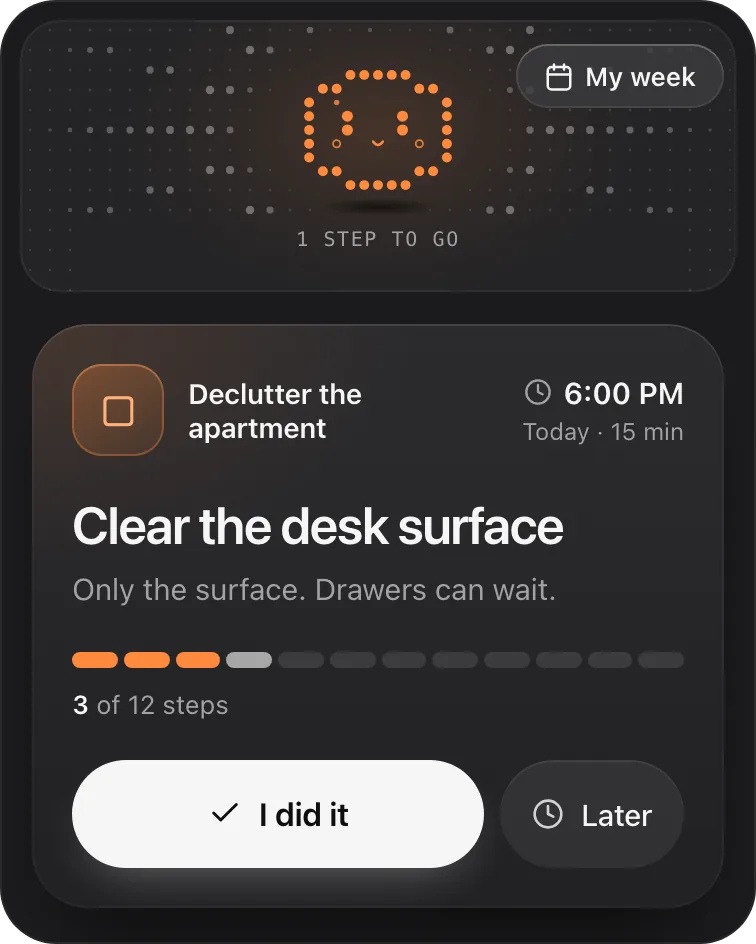
Petipa is an app inside ChatGPT that keeps the plan for you. ChatGPT breaks the goal into small steps with you; Petipa keeps the plan after the chat is closed, and never stores your conversations. Here's how it works:
- Make the plan in ChatGPT, check it, then say "save it to Petipa".
- Each day, ask "@Petipa what's my step today?" You see one step with its minutes. The rest of the plan stays out of view.
- Tap I did it when it's done, or Later if now isn't the moment. My week shows what's done and what's coming up.
Put it off for a week? Nothing is lost. Petipa welcomes you back and you start again from today. If the plan needs to change, ChatGPT proposes it and Petipa saves it only after your yes.
What it doesn't do: Petipa sends no reminders, so you still start the check-in yourself. If remembering is the hard part, set a daily phone alarm that says "ask @Petipa what's my step today?".
Petipa is in ChatGPT's plugin directory.
Enter a valid email.That didn't go through. Try again in a moment.
Add to ChatGPTQuestions
Why do people with ADHD procrastinate?
Many people with ADHD describe tasks that feel too big, unclear or dull, deadlines that don't feel real until they're close, and a loop of putting off and self-criticism. Explanations vary from person to person; what helps many people start is a smaller, more concrete first step.
How do I stop procrastinating with ADHD?
Make the first step concrete and small, give it a time and a place, set a deadline someone else knows, and allow a rough first try. After a gap, start from today with no catching up.
Why do I only get things done at the last minute?
Many people with ADHD say a close deadline is what makes a task feel real. You can bring that feeling forward with smaller, earlier deadlines: a timer, a time you promised someone, an outline due this week.
What is productive procrastination?
Doing useful tasks, like cleaning or email, instead of the one that matters most. It feels like progress, so the pattern is hard to notice. Do the first step of the avoided task before anything else.
What helps with ADHD procrastination at work?
Ask for deadlines when there aren't any, send an early short update, put the first step in your calendar by name, and end each session with a one-line note of the next step.
How do I start again after putting something off for weeks?
Don't try to make up the lost time. Pick the smallest step that still counts, do it today, and plan only the next one.
Can ChatGPT help with ADHD procrastination?
It can turn a vague task into one concrete first step, suggest a small deadline of your own, and find a smaller step when you come back after weeks away. Get the step, then close the chat: the doing happens outside it.