How to break down goals into actionable steps, down to today
A goal turns into action through a short chain: a finish line, a few milestones, this week's steps with minutes, and one step for today. Here's how to build it, and how to keep the list from becoming the next thing that stops you.
The short answer
To break down goals into actionable steps, write a finish line you could check, split the goal into three to five milestones, plan only this week's steps, and give each one a verb, a size in minutes and a minimum version. Then look at one step at a time: today's.
Why a breakdown can stop you instead of helping
Most advice on breaking down a goal ends with a list: milestones, tasks, maybe a worksheet. The list is a good start. The trouble is what happens next. A goal broken into forty tasks is still a big goal, only now it's spread over a page.
Many people who plan with ChatGPT describe exactly this. They ask for a breakdown, get a long and tidy list, and the list becomes one more pile to look at. What seems to matter is less how small each step is and more how many steps you see at once. So the method below goes all the way down to one step for today, and keeps the rest of the list out of view.
The chain: from a goal to today's step
A goal becomes action through a short chain. Each link is smaller and closer to now than the one above it:
| Link | What it is | Example |
|---|---|---|
| Goal | What you want, in your words | Get comfortable speaking Spanish |
| Finish line | What "done" looks like, so you can check it | A 10-minute conversation with a tutor, no English |
| Milestones | Three to five checkpoints on the way | Basic phrases; past tense; first tutor call; 10-minute call |
| This week | Two to five steps toward the next milestone | Learn 20 travel phrases; record myself reading a page |
| Today | One step with its minutes | Practice 10 phrases out loud, 15 min |
You only plan the bottom two links in detail. The rest stays a rough outline until you get there.
How to break down goals into actionable steps in six steps
1. Write the finish line
"Get fit" or "grow the business" can't be broken down, because there's no end to aim at. Rewrite the goal as something you could check: "run 5 km without stopping", "ten paying clients", "the spare room cleared and painted". If you can't tell whether you've reached it, keep rewriting.
Keep the horizon short where you can. A finish line four to eight weeks away is much easier to break down than one a year away. How to set goals with ADHD covers picking a goal that size.
A goal with a fixed date works the same way: the moving checklist is that chain laid out week by week before a move.
2. Split it into three to five milestones
Ask: what has to be true halfway there? A quarter of the way? Each milestone is a smaller finish line, also something you could check. Three to five is enough. More than that and the milestones turn into a task list of their own.
Make each milestone a piece you can finish, like one room or one chapter, so stopping after it never leaves a half-done job.
3. Plan this week only
Take the next milestone, not all of them, and list the steps for this week. Two to five is plenty. Steps for later milestones wait until you get there, because by then you'll know more and some of them will have changed.
If you want a way to lay out the week itself, the ChatGPT weekly planner walks through it.
4. Make each step actionable
A step is actionable when you could start it right now without deciding anything first. Check each one for four things:
| Missing | Not yet actionable | Actionable |
|---|---|---|
| A verb | Website | Write the About page text |
| One clear object | Research | Read two pricing pages and note what they charge for |
| A size in minutes | Practice guitar | Play the G to C change, 10 min |
| A done check | Work on the budget | List last month's bills in one note, done when every bill is on it |
Keep most steps at 25 minutes or less. A step that needs an hour is usually two or three steps.
5. Give each step a minimum version
Write a smaller version next to each step: the least that still counts. "Run 3 km, 25 min" gets "Walk 10 minutes in running shoes". "Write the About page, 25 min" gets "Write its first sentence".
On a low-energy day you do the minimum and the step still moves the goal. That way a hard day bends the plan instead of breaking it. If you feel like doing more after the minimum, you can, but you don't have to.
6. Look at one step at a time
Keep the milestones and the week's list somewhere you don't read every day. Each day, pick one step for today and look only at that. When it's done, you can pick another or stop.
At the end of the week, check what got done, move what's left to next week or drop it, and plan the next few steps. Don't count what didn't happen: the question is only what comes next.
When a step won't start
Sometimes a step looks actionable on paper and you still can't begin. That usually means it's still too big or too vague. Shrink it until the first move is physical and takes a couple of minutes: "open the document and write the heading", "put the running shoes by the door".
If it still won't start, ask what you'd have to decide first, and make that decision the step. How to start a task covers that first minute in more detail.
SMART goals and big goals
A SMART goal (specific, measurable, achievable, relevant, time-bound) is already most of a finish line, so start at step 2. The usual gap with SMART goals is that they stop at the goal: they say what and by when, but not what to do this morning. The chain above fills that gap.
A big goal, like changing careers or writing a book, works the same way with one more layer. Treat the big goal as the direction, and set a first piece you can finish in four to eight weeks as the finish line. Break down only that piece. When it's done, set the next one.
Use ChatGPT to build the chain
ChatGPT is good at the tedious part: turning a rough goal into milestones and steps. Ask it to ask you first, and to show you only this week:
Help me break down a goal into actionable steps.
My goal: [what you want, in your own words].
Ask me up to 3 questions first: what "done" looks like,
how much time I really have each week, and what's in my way.
Then give me:
- a one-line finish line I could check
- 3 to 5 milestones, each something I could check
- this week's steps only, 2 to 5 of them, each with a verb,
  minutes (25 or less) and a minimum version
Show me the week's steps last. Keep it short.
ChatGPT tends to agree with the plans it's shown, and it often makes breakdowns too long. Push back before you commit:
Here's my plan: [paste it].
Which steps are vague enough that I'll stall on them?
What could I cut and still reach the finish line?
Are any of these time estimates unrealistic?
And when one step won't start:
This step won't start: [the step].
Shrink it to the first physical action I could do
in 2 minutes. Give me only that, nothing else.
Treat its time estimates as guesses, and adjust them once you see how long steps really take. If you plan in ChatGPT, a project keeps the related chats together, so the plan is easier to find when you come back. Then close the chat and do the step: the step is where the goal moves.
All of this works on paper too: one page with the finish line and milestones, one with this week's steps.
If you've broken the goal down and still don't start, how to stop procrastinating takes it from there.
How Petipa helps with the last link
The chain is easy to build in a chat. The weak spot is the bottom link: each day you have to find the plan again, scroll past the whole breakdown, and pick today's step from it. That's the moment the list turns back into a pile.
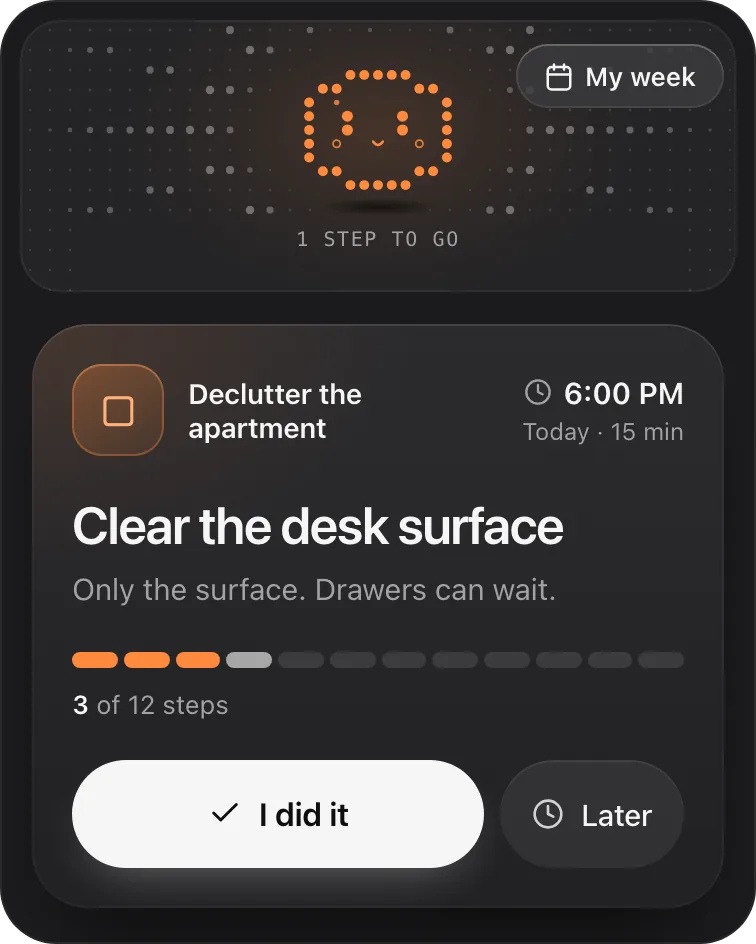
Petipa is an app inside ChatGPT that keeps a plan like this and shows you one small step at a time. ChatGPT helps you break the goal down; Petipa remembers the plan after the chat is closed, and never stores your conversations. Here's how it works:
- Build the milestones and steps with ChatGPT, adjust them until they fit your week, then say "save it to Petipa".
- Each day, ask "@Petipa what's my step today?". You see one step with its minutes, and the rest of the plan stays out of view.
- Tap I did it when it's done, or Later if today isn't the day. My week shows what's done and what's next this week.
Away for a few days? Nothing is lost. Petipa welcomes you back calmly, and you pick up from the next step. If the plan needs to change, Petipa asks before it changes it.
What it doesn't do: Petipa sends no reminders, so the cue to ask is yours. A phone alarm that says "ask @Petipa what's my step today?" covers that, and depending on your ChatGPT plan, a scheduled task can send you a message too. Petipa also doesn't decide what your goal should be or whether a step is the right one: that stays with you and your plan.
Petipa is in ChatGPT's plugin directory.
Enter a valid email.That didn't go through. Try again in a moment.
Add to ChatGPTQuestions
How do I break down a goal into steps?
Write a finish line you could check, split the goal into three to five milestones, and list only this week's steps toward the next milestone. Give each step a verb, a size in minutes and a minimum version, then do one step at a time.
What makes a step actionable?
A step is actionable when you could start it now without deciding anything first. It has a verb, one clear object, a size in minutes and a way to tell when it's done.
How do I break down goals into manageable sizes?
Keep most steps at 25 minutes or less, plan only one week at a time, and look at one step per day. If a step still feels too big, shrink it to a first physical action that takes a couple of minutes.
How do I break down a SMART goal?
A SMART goal is already a finish line, so start with the milestones: three to five checkpoints you could check. Then plan this week's steps toward the next one, each with a verb and minutes.
Can ChatGPT break down my goals for me?
It can turn a rough goal into a finish line, milestones and a week of steps. It tends to agree and to make lists long, so ask it what to cut and which steps are vague, and treat its time estimates as guesses.