How to stop procrastinating: six steps for the task you keep putting off
A step-by-step way to get going on the one task you keep avoiding, with a fix for each reason you put it off and a prompt to copy.
The short answer
To stop procrastinating, name the exact task you're avoiding and what makes it unpleasant, shrink it to a first step you can do in two minutes, decide when and where you'll do it, remove one obstacle, and start. If you put it off again, restart from a smaller step, without guilt.
Why you procrastinate (it's rarely about time)
Procrastination is putting off something you mean to do, even when you know waiting will make it harder. It's rarely about poor planning or not caring. Usually, the task feels unpleasant right now: too big, unclear, boring, or risky to get wrong. Something else feels better, so you do that instead.
Putting it off brings relief for a moment. Then the task comes back, a little heavier, and the relief makes it easier to put off again. That's the loop.
So the way out isn't more willpower or a stricter schedule. It's making the task smaller, clearer and easier to begin, then starting before you feel ready. Being hard on yourself doesn't help: it makes the task feel worse, which makes it easier to avoid.
How to stop procrastinating, step by step
These six steps are for one task you keep avoiding. If you have a long list and can't choose, pick by one rule, such as the soonest deadline or the task that would bring the most relief, and start with that one.
1. Name the task, and what makes it hard
Write the task down in a few words, as something you could finish: not "taxes" but "file my tax return". Then write one more line: what about it feels bad? It might be too big, unclear, boring, or scary to get wrong. That line tells you which fix to use (see the table below).
2. Shrink it to a first step you could do in two minutes
You can't do a whole task at once, only its first step. Make it physical, start it with a verb, and keep it small enough that it feels almost too easy.
| The task you're putting off | A first step you could do in two minutes |
|---|---|
| Call the insurance company | Find the policy number and put it next to your phone |
| Study for the exam | Open your notes for the first chapter and read one page |
| Write the cover letter | Type one rough first sentence |
| Return the package | Put the package by the front door |
| Write the quarterly report | Open a new document and paste in last quarter's headings |
| Book the dentist | Look up the clinic's phone number |
If the step still feels heavy, shrink it again. "Find the policy number" can become "open the folder where insurance papers go". For a goal that takes weeks rather than one sitting, see how to break down goals into actionable steps.
3. Decide exactly when and where
"Later" has no time in it, so it never arrives. Finish this sentence: "At [time], at [place], I'll [first step]." For example: "At 9 tomorrow, at the kitchen table, I'll find the policy number."
Tying the step to something you already do helps too: after your morning coffee, right after lunch, as soon as you sit down at work. Write the sentence where you'll see it, on a sticky note or in your phone.
4. Remove one obstacle
Make starting a little easier, or the distraction a little harder. Pick the one change that would help most:
- Put your phone in another room, or at least out of reach.
- Close every tab except the one you need.
- Set things out the night before: the document already open, the papers on the table, the shoes by the door.
One change is enough. Redesigning your whole desk can become another way to put the task off.
5. Start for two minutes, and allow yourself to stop
Set a timer for two minutes and do the first step. When it rings, you're allowed to stop. Starting counts.
Often you'll keep going, because starting was the hard part. If you do, work for about 25 minutes, then take a five-minute break, and repeat if you want to.
6. If you put it off again, restart without guilt
It will happen sometimes. When it does, don't try to make up for the lost days by stacking everything onto tomorrow. Ask two questions instead:
- Was the step too big? Shrink it again.
- Was the time wrong? Pick a new one, ideally earlier in the day.
Then start from today. Forgiving yourself for the last delay isn't letting yourself off the hook. It takes away some of the dread, and dread is what made the task easy to avoid in the first place.
Match the fix to the reason
The same advice doesn't fit every reason. Use the line you wrote in step 1:
| Why it feels hard | What it sounds like | Try this |
|---|---|---|
| It's too big | "This will take forever" | Shrink it to a two-minute step, and decide in advance where you'll stop today |
| It's unclear | "I don't even know where to start" | Make the first step "find out": look up one thing, or ask one person one question |
| It's boring | "Ugh, not this" | Pair it with something you like (music, a podcast, a good drink), or do it somewhere new |
| You're afraid of doing it badly | "It has to be perfect" | Aim for a rough first version you'll fix later. Done badly can be improved; not started can't |
| There's no deadline | "I'll get to it whenever" | Set your own date and tell someone, so the date is real |
| You're tired | "I can't face it today" | Do the smallest version that still counts, at the time of day you have the most energy |
How to beat procrastination right now, in five minutes
If you need to start this minute, skip the reading and do this:
- Write the task on paper.
- Under it, write the first step, starting with a verb.
- Put your phone out of reach.
- Set a timer for two minutes.
- Start. When the timer rings, decide whether to keep going.
That's the whole method in miniature. The rest of this page is how to make it work when the task is bigger or keeps coming back.
How to stop procrastinating and get motivated
Many people wait to feel motivated before they start. Motivation often works the other way around: it shows up a few minutes after you begin, once the task looks smaller than it did in your head. So don't wait for it. Make the first step small enough that you don't need much.
Two things help it grow once you've started:
- See the progress. Cross off each step, or keep a short "done today" list. A finished step is proof the task is moving.
- Reward the start, not just the finish. A coffee after the first 25 minutes, a walk after the hard email.
How to stop procrastinating at work and when studying
At work:
- When a task has no deadline, ask for one: "When do you need this by?"
- Put the first step of a big project in your calendar as a short block, with the step as its title.
- Tell a colleague when you'll send something. A date someone else knows is easier to keep.
- Before you stop for the day, write the next step in one line, so tomorrow starts there instead of at zero.
When studying or doing homework:
- Decide what "done for today" means before you start: one chapter, ten problems, one page of notes.
- Study in blocks of about 25 minutes with a five-minute break, phone in another room.
- Start with the easiest problem to warm up, or the hardest one while you're fresh. Either works; deciding in advance is what matters.
How to overcome procrastination for good
Nobody stops procrastinating forever, and you don't need to. What lasts is a small habit you can repeat: a two-minute first step, a set time for it, and a quick restart when a day doesn't go to plan. The goal isn't to never put things off. It's to get back to the task sooner each time.
Use ChatGPT to get unstuck
Many people who plan with ChatGPT use it to find a way in: a first step, or a rough draft to fix instead of a blank page. Copy this, fill in the brackets, and send it:
I keep putting off this task: [task].
What makes it hard: [too big / unclear / boring / afraid of doing it
badly / no deadline / tired].
I have [minutes] right now, and I'm at [place].

Give me:
1. One first step I can do in two minutes, starting with a verb.
2. One obstacle to remove before I start.
3. One sentence for when and where I'll do it.
Keep it under 80 words. Don't give me a full plan.
If the step still feels too big:
That step still feels too big. Make it smaller and more physical.
If you put it off again yesterday:
I put this off again. Don't comment on it. Give me a smaller first
step for today, and a better time to do it.
If a blank page is the problem:
Write a rough first draft of [the email / the first paragraph / the
outline] that I can fix. Keep it short and plain.
One caution: talking a task through with ChatGPT can feel like progress while the task itself doesn't move. Get the step, close the chat, and do it. And if you'd rather not use ChatGPT at all, every step on this page works with paper and a pen.
How Petipa keeps the next step in view
Some things you put off are bigger than one sitting: a course, a move, getting back into exercise. For those, getting started once is only day one. The harder part is finding the next small step each day without facing the whole plan again.
Petipa is an app inside ChatGPT that keeps the plan for you. ChatGPT breaks the goal into small steps with you; Petipa keeps the plan after the chat is closed, and never stores your conversations. Here's how it works:
- Make the plan in ChatGPT, check it, then say "save it to Petipa".
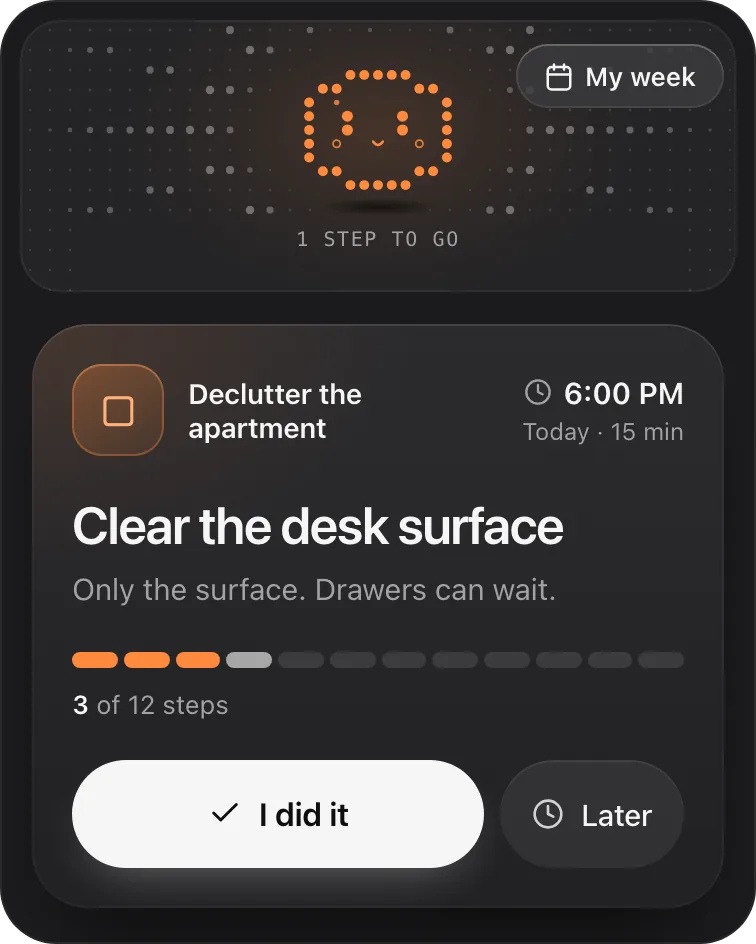
- Each day, ask "@Petipa what's my step today?" You see one step with its minutes, and the rest stays out of view.
- Tap I did it when it's done, or Later if now isn't the moment. My week shows what's done and what's coming up.
Put it off for a few days? Nothing is lost. Petipa welcomes you back and you start again from today. If the plan needs to change, ChatGPT proposes it and Petipa saves it only after your yes.
What it doesn't do: Petipa sends no reminders, so you still start the check-in yourself. A daily phone alarm that says "ask @Petipa what's my step today?" covers that.
Petipa is in ChatGPT's plugin directory.
Enter a valid email.That didn't go through. Try again in a moment.
Add to ChatGPTQuestions
Why do I procrastinate so much?
Usually because the task feels unpleasant right now: too big, unclear, boring, or risky to get wrong. Putting it off brings quick relief, which makes it easier to do again. Naming what feels bad tells you which fix to try.
Is procrastination the same as being lazy?
No. Procrastination usually means wanting to do the task, worrying about it, and still putting it off. It's a way of avoiding how the task feels, and it responds to smaller steps and set times, not to harsher words.
How do I stop procrastinating immediately?
Write the task and its first step, put your phone out of reach, set a timer for two minutes and start. You can stop when it rings. Often you won't want to.
How do I stop procrastinating and get motivated?
Start before you feel motivated. Motivation often shows up a few minutes after you begin, so make the first step small enough that you don't need much, and cross off each step you finish.
How do I stop procrastinating on homework or studying?
Decide what "done for today" means, pick a time, put your phone in another room, and work in blocks of about 25 minutes with short breaks. Start with one page or one problem, not the whole subject.
How do I overcome procrastination for good?
No one stops putting things off forever. What lasts is a habit of small first steps, a set time for each task, and a quick, guilt-free restart when a day doesn't go to plan.
Do these steps work if I have ADHD?
Many people with ADHD use the same steps, plus a few extras, like a deadline someone else knows and a first step that's concrete as well as small. See ADHD procrastination for those.