How to set goals you'll actually keep, one small step at a time
A plain way to set a goal you'll still be working on in a month: one goal at a time, a short horizon, steps with minutes, a version for low days, and a restart rule written before you need it.
The short answer
To set goals you'll keep, pick one goal you want for the next four to eight weeks, write it as something you'll do rather than something you'll be, cut it into steps with minutes, give each step a low-day version, and decide now how you'll restart after a gap.
Why goals fade after a few weeks
The pages that rank for this question mostly agree on the basics: make a goal specific and measurable, keep it realistic, give it a deadline, break it into smaller steps, write it down and review it. That advice is sound. What it rarely does is turn a goal into the thing you open on a Tuesday: one written step, with a size, that you can start today.
Two things usually end a goal. The first is a plan too big to begin, so the first step never happens. The second is a gap: a busy week or a cold, and coming back feels like starting over, so you don't. A goal that lasts needs a first step small enough to start and a plan for coming back. The six steps below cover both.
How to set goals in six steps
1. Pick one goal, and pick it because you want it
Choose one goal for now. Others can wait on a list. A goal you picked because you think you should tends to fade first, so ask yourself plainly: if nobody else ever knew, would I still want this?
If you're torn between several, pick the one where a small step this week would feel good. You can add the next goal once this one is running on its own.
2. Set a short horizon
Give the goal four to eight weeks, not a year. A short horizon makes the finish line visible and makes it easier to judge whether the plan fits your life. If the real goal is long, like a new career or a degree, set the first four to eight weeks as its own goal: "Finish the first online course module" instead of "Change careers".
3. Write it as something you'll do
"Get fit" is a wish. "Walk three times a week for six weeks" is a goal you can do on a given day. Write the goal as an action, with how often and for how long. That's also what the SMART format asks for: specific, measurable and time-bound, while steps 1 and 4 cover achievable and relevant.
4. Cut it into steps with minutes
Break the goal into steps that each start with a verb and carry a rough time: "Find a beginner podcast, 10 min", "Listen to episode one, 20 min". A step with minutes has a clear size and a clear end. If a step still feels heavy, split it until the first piece looks easy to start. How to break down goals into actionable steps covers this part in more detail.
Keep the full list somewhere you don't have to read every day. Seeing every step at once can make the goal feel like a mountain, while seeing one step makes it one small thing.
5. Give each step a low-day version
Next to each step, write the smallest version that still counts:
| Step | Low-day version |
|---|---|
| Walk 30 min | Walk to the end of the street and back, 5 min |
| Practice Spanish, 15 min | Review five words, 3 min |
| Write for 20 min | Write one sentence, 2 min |
On a low-energy day, you do the small version and call it done. It keeps the goal alive on the days when the full step won't happen.
6. Decide how you'll restart
Write your restart rule now, while you feel good, so you don't have to invent it later:
- Don't count the days you were away, and don't make them up.
- Do today's step, or its low-day version.
- If the goal no longer fits your life, make it smaller rather than pushing harder.
A smaller goal you return to beats a bigger one you avoid.
How to set goals examples, by area of life
A goal you can do names an action, how often, and for how long. Here's the same change from wish to goal in common areas of life:
| Area | Wish | Goal you can do | First step |
|---|---|---|---|
| Health | Get fit | Walk 30 minutes three times a week for six weeks | Pick a route and put shoes by the door, 5 min |
| Learning | Learn Spanish | Practice Spanish four days a week for six weeks | Download a free lesson and do the first one, 15 min |
| Money | Save money | Move a set amount to savings each payday for two months | Set up the automatic transfer, 10 min |
| Home | Get organized | Clear one surface a week until the kitchen is clear | Clear the counter by the stove, 15 min |
| Work | Grow my career | Finish one short course on a skill my job uses in six weeks | Choose the course and read its outline, 15 min |
| Creative | Write more | Write for 20 minutes three mornings a week for a month | Open a blank document and title it, 2 min |
| People | See friends more | Call or meet one friend each week for two months | Text one friend to pick a day, 3 min |
Each first step takes minutes and needs nothing else first. That's the test of a good one.
A goal setting template you can copy
Paste this into a note, a notebook page or a doc, and fill it in once. It's the whole goal planner on one page.
My goal (an action, how often, for how long):
Why I want it, in my own words:
Finish date (four to eight weeks from today):

Steps, each starting with a verb, with minutes:
1.
2.
3.

Low-day version of each step (under 5 minutes):

When I'll do it (days and a rough time):
My cue to start (an alarm, after coffee, after work):

Restart rule: skip counting the days I was away,
do today's step or its low-day version,
and make the goal smaller if it no longer fits.

Check-in date (end of week four):
At the check-in, look back for two minutes: what got done, what was too big, and whether to keep going, shrink the goal or set the next one.
How to set goals in life, not only for this month
Goals that run for months or years are worth having, but the plan for them works best in short pieces. Set the long goal as a direction, then set the next four to eight weeks as the goal you actually plan. At the end of each block, look back briefly and set the next one. Over a year, that's six to twelve short goals that point the same way, each with a finish line you can see.
To be honest about the evidence: most of what people share online about planning is about getting through the day and the week. Far fewer accounts follow a goal over months, so treat any long-term method, including this one, as something to adjust as you go.
New year goals that last past January
A new year is a good moment to set a goal, and a hard one to keep it through, because everything starts at once. Three things help:
- Start one goal on January 1, not five. Add a second in February if the first is running on its own.
- Plan the first four weeks only. Plan February at the end of January, once you know what a real week looks like.
- Write the restart rule before the first busy week, so the first gap is a pause, not the end.
For ideas to choose from, each with a first step, see new year resolution ideas.
If you have ADHD
Many people with ADHD describe a familiar loop with goals. A goal feels exciting when it's set, the plan is big and detailed, and a week later it's hard to remember where it lives. In what people share online about planning, a gap often feels like the end of the goal rather than a pause in it.
The same six steps apply, with a few adjustments people often find useful:
- Keep one step visible, not the whole list. A long list can turn into one more thing to avoid.
- Make the low-day version really small, two to five minutes, so there's always a version that fits.
- Bring your own cue. A phone alarm at the time you plan to start does more than a goal written in a notebook you don't open.
- Expect gaps and plan the restart. Aim for most days, not every day. How to be consistent with ADHD covers that idea in more detail.
Use ChatGPT to draft the goal
If turning a wish into steps is the hard part, ChatGPT can draft it. Keep the prompt short and ask it to ask you first:
Help me set one goal for the next 6 weeks: [what you want].
Ask me up to 3 questions first: how much time I really have,
what has stopped me before, and why this matters to me.
Then write the goal as an action, list steps that start with a verb
with minutes on each, and add a low-day version under 5 minutes.
Show me the first three steps only. Keep it short.
ChatGPT tends to agree with the plans it's shown, so ask it to push back before you commit:
Here's my goal and plan: [paste it]. Here's a normal week for me: [describe it].
Is this too much? What would you cut so it still works in a busy week?
What am I not considering?
Treat its time estimates as guesses, and adjust them once you see how long steps really take. For more prompts, with sizing and a weekly plan, see the ChatGPT goal setting prompt.
Then close the chat and do the first step. Talking a goal through can feel like progress, but the step is where the goal actually moves. Everything here works on paper too: the template above, a notebook and an alarm on your phone.
How Petipa helps you keep the goal going
A goal drafted in a chat has one weak spot: the plan scrolls away, and after a few days off, finding your place means rereading the whole conversation.
Petipa is an app inside ChatGPT that keeps a plan like this and shows you one small step at a time. ChatGPT helps you set the goal; Petipa remembers the plan after the chat is closed, and never stores your conversations. Here's how it works:
- Draft the goal with ChatGPT, adjust it until it fits your week, then say "save it to Petipa".
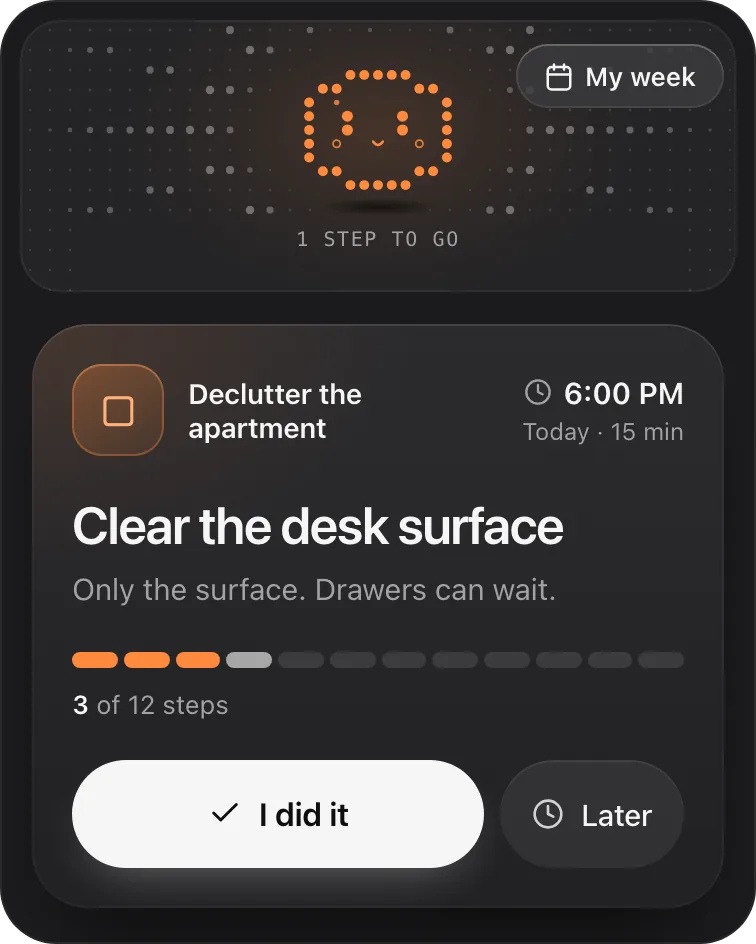
- Each day, ask "@Petipa what's my step today?". You see one step with its minutes, and the rest stays out of view.
- Tap I did it when it's done, or Later if today isn't the day. My week shows what's done and what's next this week.
Away for a few days? Nothing is lost. Petipa welcomes you back calmly and you pick up from today. If the plan needs to change, Petipa asks before it changes it.
What it doesn't do: Petipa sends no reminders, so the cue to check in is yours. A daily phone alarm that says "ask @Petipa what's my step today?" covers that, and depending on your ChatGPT plan, a scheduled task can send you a daily message too. Petipa also doesn't choose your goal or judge how it's going: that stays with you, and your conversation with ChatGPT.
Petipa is in ChatGPT's plugin directory.
Enter a valid email.That didn't go through. Try again in a moment.
Add to ChatGPTQuestions
How do I set goals for myself?
Pick one goal you want for the next four to eight weeks, write it as an action with how often and for how long, and cut it into steps with minutes. Add a low-day version of each step and a rule for restarting after a gap.
How do I set goals and achieve them?
Make the first step small enough to start today, keep only that step in view, and give every step a version that fits a low day. Then plan the restart before you need it, since a gap is where many goals end.
What are some examples of good goals?
"Walk 30 minutes three times a week for six weeks", "Practice Spanish four days a week for six weeks" and "Move a set amount to savings each payday for two months". Each names an action, how often and for how long.
What are the steps of goal setting?
Pick one goal, give it a short horizon, write it as an action, cut it into steps with minutes, add a low-day version, and decide how you'll restart. Then check in after four weeks.
Do SMART goals work?
They help, since specific, measurable and time-bound goals are easier to act on. Many people find they work better with two additions: a low-day version of each step and a plan for restarting after a gap.
How do I set goals with ADHD?
Use the same steps, keep only one step visible, make the low-day version two to five minutes, and set your own cue, like a phone alarm. Aim for most days rather than every day, and plan the restart ahead of time.
Can ChatGPT help me set goals?
It can help you draft the goal, cut it into steps with minutes and check it against your week. It tends to agree with your plans, so ask it what you're not considering, and treat its time estimates as guesses.