How to brain dump, and what to do with the list after
Ten minutes to get everything out of your head, five to sort it, and one first step you can do today, on paper or with ChatGPT.
The short answer
To brain dump, write down everything on your mind, in any order and without sorting, until it's out of your head and in one place. Set a timer for 10 minutes and keep going until it rings. Then sort the list: cross out what can go, note what has a date, and pick one first step you can do today.
What is a brain dump?
A brain dump is a list of everything you're carrying in your head: tasks, errands, worries, ideas, things you're waiting on, all written down at once in no particular order. The point is to move it out of your head and into one place you can look at.
It isn't a to-do list. A to-do list is sorted and meant for doing. A brain dump is raw, and it comes first; the sorting comes after. Many people describe real relief at seeing it all on one page, but a dump on its own doesn't tell you what to do first. That second half is the part people tend to skip, and it's what makes a brain dump useful.
When to do a brain dump
- When your head feels too full to pick anything.
- At the start of the week, before you plan it.
- At the end of the day, so tomorrow's tasks are on paper instead of going round in your head. Some people do a short one before bed.
- After a few days away from your plans, to see what's still there.
- Before a big change: a move, a new job, a new term.
How to brain dump in 10 minutes
- Pick one place. One page, one note, one doc, not three. Paper works, a notes app works, and a voice memo works if writing feels slow.
- Set a timer for 10 minutes. A limit makes it easier to start, and it gives you a finish line.
- Write everything, in any order. Big and small together: "renew passport" next to "buy milk". Don't sort, judge or fix anything yet. If it comes to mind, it goes on the page.
- Use the questions below when you slow down.
- Stop when the timer rings. If more comes later, add it then. A brain dump doesn't have to be complete to help.
Questions to empty your head
When the list stalls, walk through these:
- Work or school: What's due? What did I say I'd do? What am I waiting on from someone?
- Home: What's broken, running out, or needs cleaning?
- Money and paperwork: Bills, forms, renewals, refunds.
- People: Who do I need to call, answer or thank?
- Errands and appointments: What do I need to buy, book or drop off?
- Plans and ideas: What do I want to start, learn or try?
- Worries: What keeps coming back to mind? Write it down, even if there's nothing to do about it today.
How to organize a brain dump: sort it into a short list
A long page with everything on it can feel heavier than having nothing written down. Five minutes of sorting turns it into something you can use. Go through the list once and put each line in one of four groups:
| Group | What goes there | What happens to it |
|---|---|---|
| This week | What really matters in the next few days | This week's list. Three things at most |
| Has a date | Appointments, deadlines, renewals | Your calendar, with the date |
| Later | Ideas and tasks that can wait | A "later" list you don't read every day |
| Let go | What no longer matters, or a worry that isn't a task | Crossed out |
Then the step that's easiest to skip: pick one thing from "This week" and write its first step. Not "sort out the car", but "find the insurance letter and put it by the door". It should start with a verb and take a few minutes. That's what you do today. If even that won't start, how to start a task has a way to shrink it further.
Keep the whole page. The "Later" list is where ideas wait, not where they disappear. Glance at it once a week, during your next dump.
How to brain dump with ADHD
Many people with ADHD describe thoughts that arrive from everywhere at once, and notes spread across apps, paper and sticky notes. A brain dump helps, with a few changes:
- Talk instead of write if writing feels slow. Record a voice memo, then type it out or paste it into ChatGPT (below).
- Keep one front door. Wherever a thought shows up, it goes to the same note. Two inboxes turn into two piles.
- Dump in short rounds. Ten minutes, then stop. A dump that runs for an hour becomes its own project.
- Hide the pile after sorting. Keep the full list where you don't have to look at it, and keep only today's step in view. Seeing the whole list every morning is what many people describe as the overwhelming part.
- Expect it to get messy again. Dump again each week, or whenever your head feels full. Coming back after weeks with no dump isn't starting over: it's just the next dump.
If the list is sorted and you still can't get going, ADHD motivation covers how to add a deadline, a change of place, a challenge or company to that first step.
Turn a brain dump into a plan with ChatGPT
ChatGPT is quick at the part that's hard to do alone: sorting a messy list and picking what comes first. Paste your dump, as messy as it is, into this prompt:
Here's my brain dump, in no order:
[paste everything]

I have about [minutes] a day for my own tasks this week.

1. Sort it into four groups: This week (at most 3 things),
   Has a date, Later, and Let go. Keep each line short.
2. For each of the 3 things this week, give a short plan:
   2 to 4 steps, each starting with a verb, with minutes.
3. Then pick ONE first step I can do today in under 10 minutes,
   and show it on its own line at the end.
Don't add anything I didn't write. If a line is unclear, ask me
one question before you sort.
If one of the three still feels too big:
[thing] still feels too big. Break it into steps of 15 minutes
or less, and show me only the first one.
A few things make this work better:
- Keep sensitive details out. You don't need account numbers, health details or other people's private matters to sort a list: "call the bank" is enough.
- Check the sort. ChatGPT can misread a line, and it tends to go along with how you framed things. Move anything that landed in the wrong group.
- Keep the list outside the chat. ChatGPT's memory, when it's on, keeps relevant details from your chats, not every detail of every conversation, so don't count on it to hold your list. Copy the sorted version back into your own note.
- Then do the first step. Get the step and close the chat.
For prompts that plan the rest of your day or week, see the ChatGPT planner.
A simple brain dump template
Copy this into a notes app or onto a sheet of paper:
BRAIN DUMP · [date] · 10 minutes

Everything on my mind:
-
-
-

This week (3 at most):
1.
2.
3.

Has a date:
-

Later:
-

Let go:
-

Today's first step (under 10 minutes):
Keep one plan from the dump going with Petipa
The brain dump itself stays in your own note or notebook: that's where the whole list belongs. When one item turns into something you want to follow over days or weeks, like "clear out the spare room" or "get my paperwork in order", Petipa can keep that plan. Petipa is an app inside ChatGPT, and it never stores your conversations. Here's how it works:
- Turn one item into a plan with ChatGPT, adjust it until the steps feel doable, then say "save it to Petipa".
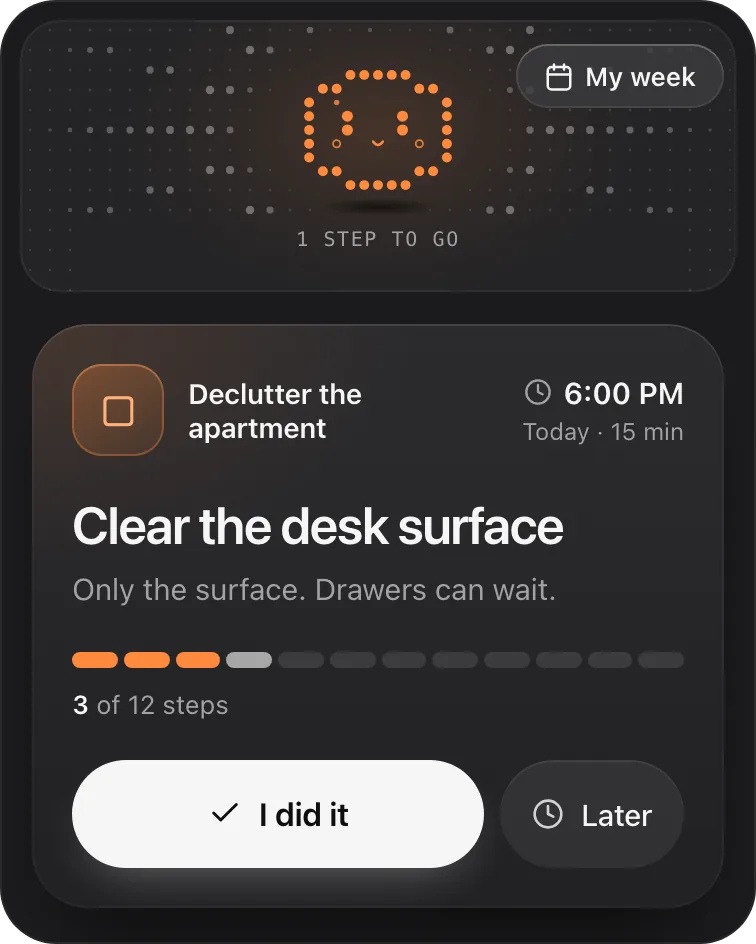
- Each day, ask "@Petipa what's my step today?" You see one step with its minutes, and the rest of the plan stays out of view.
- Tap I did it when it's done, or Later if now isn't the moment. My week shows what's done and what's next.
Took a few days off? Nothing is lost: Petipa welcomes you back and you pick up from today. If the plan needs to change, ChatGPT proposes it and Petipa saves it only after your yes.
What it doesn't do: Petipa isn't a place to dump every thought, and it sends no reminders. Keep the brain dump in your own note, and set your own alarm to ask for today's step.
Petipa is in ChatGPT's plugin directory.
Enter a valid email.That didn't go through. Try again in a moment.
Add to ChatGPTQuestions
What is a brain dump?
A brain dump is writing down everything on your mind at once, in no order, so it's out of your head and in one place. You sort it afterward into a short list and one first step.
How do I brain dump my thoughts?
Pick one page or note, set a timer for 10 minutes, and write whatever comes to mind without sorting. When you slow down, go through work, home, money, people, errands, ideas and worries.
What do I do with my brain dump list?
Sort it into four groups: this week (three things at most), has a date, later, and let go. Then pick one thing from this week and write its first step, small enough to do today.
How often should I do a brain dump?
Once a week works for many people, plus any time your head feels too full. After a long gap, just do the next one; there's nothing to catch up on.
Should I brain dump before bed?
Some people do a short one at the end of the day so tomorrow's tasks are on paper, not in their head. Keep it to a few minutes, and leave the sorting for the morning.
Can ChatGPT help with a brain dump?
Yes. Paste your dump and ask it to sort the list into groups, plan up to three things, and pick one first step for today. Keep sensitive details out, check its sort, and keep the final list in your own note.